
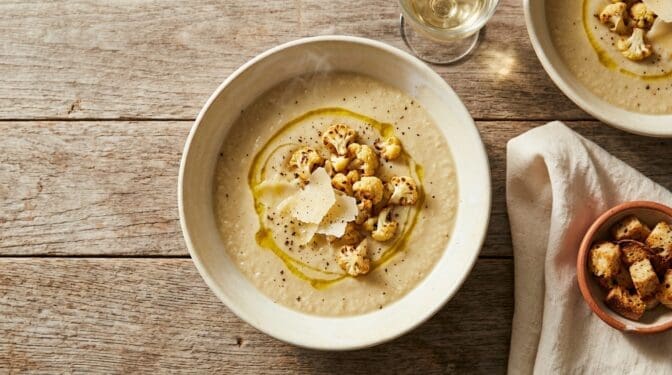
A whole roasted cauliflower blended with cream and parmesan into a velvet-textured soup, scattered with extra roasted florets and a swirl of best olive oil. Vegetarian, savoury, deeply unflattering to a dinner that ate three meals before this one.
Why you should cook this
The first cauliflower soup I ever made was a 2014 Yotam Ottolenghi recipe that called for tahini and pomegranate seeds and an essence of brown butter, and I made it for a dinner party of four people, two of whom were on a low-carb regimen and one of whom was vegan, which meant the cream had to come out and the parmesan had to come out and I was effectively serving them blended cauliflower with sad oil on top. The soup was fine. The dinner party was a failure. I learnt two things that night. One: do not invite vegans and low-carb diners to the same dinner. Two: a cauliflower soup needs the cream and the parmesan to taste like a soup. Without them it tastes like vegetable mash through a sieve.
That is the dish. A whole cauliflower roasted in the oven until the florets are amber-brown and slightly charred at the edges, then blitzed with a stick blender into hot stock with cream and parmesan, finished with a swirl of olive oil and a scatter of the reserved roasted florets and a fresh grating of parmesan. The roasting is the trick. A boiled cauliflower goes pale and sulphurous; a roasted cauliflower develops nutty caramelised edges that turn the soup deeply savoury. The cream is the texture. The parmesan is the umami. The olive oil at the end is the gloss.
Use a whole head of cauliflower, about a kilo, with the leaves and the core (do not throw the leaves out; they roast brown and become a garnish). Buy a cauliflower at a greengrocer rather than a supermarket; the supermarket version has been sitting under fluorescent light for four days and the texture suffers. A fresh cauliflower from Harris Farm or a Saturday farmer’s market is significantly tastier and costs a dollar more. Worth it.
The other ingredient that matters is the stock. Homemade chicken stock will make the soup transcendent, but you do not need it. A boxed Coles Finest chicken stock is fine. A vegetable stock works too if you want to keep the dish vegetarian; pick one with mushroom or porcini for added depth (Massel Vegetable Cubes, dissolved in hot water, is the everyday workhorse). Avoid Continental cube stock; the MSG dominates the cauliflower.
What to drink with it
An off-dry Riesling or a lightly oaked Chardonnay. The Riesling provides the acidity to cut the cream; the Chardonnay matches the parmesan’s weight. Pewsey Vale Eden Valley Riesling at $25 from Dan Murphy’s is the everyday Riesling pour; Oakridge Yarra Valley Chardonnay at $22 is the everyday Chardonnay. If white wine is not the move, a Tasmanian sparkling (Jansz NV at $30) does the same job with bubbles. Avoid heavy red; the soup is delicate and a Shiraz will smother it.

Recipe · Dinner
Winter Vegetable Soup
Three hours of slow extraction, an old parmesan rind, a few cheap vegetables. The soup the Italians have been quietly winning at since the fourteenth century. Why you…
Read the recipe →
Recipe · Dinner
Potato and Leek Soup
Six ingredients, twenty minutes, a blender, a winter Tuesday solved. The soup that justifies still owning a blender. Why you should cook this The first time I made…
Read the recipe →Notes from the kitchen
Roast the cauliflower hard. Break the head into florets, toss with a generous glug of olive oil and a generous pinch of salt, spread in a single layer on a baking tray (do not crowd; crowded cauliflower steams), and roast at 220°C for 25 minutes until the edges are deeply browned and slightly charred. The browning is the dish. A pale roasted cauliflower will give you a pale flat soup; a deeply browned cauliflower will give you a deeply savoury soup. Use convection if you have it; the air circulation gets you better browning.
Reserve a third of the roasted florets for the garnish. Blend the rest with hot stock and cream using a stick blender right in the pot, until silky smooth (a high-speed blender will give you an even silkier texture if you have one; pour the soup back into the pot to keep warm). Stir in the grated parmesan off the heat (parmesan added to a boiling soup will go stringy and grainy; off the heat it melts into the soup). Adjust seasoning. Salt generously; cauliflower needs salt.
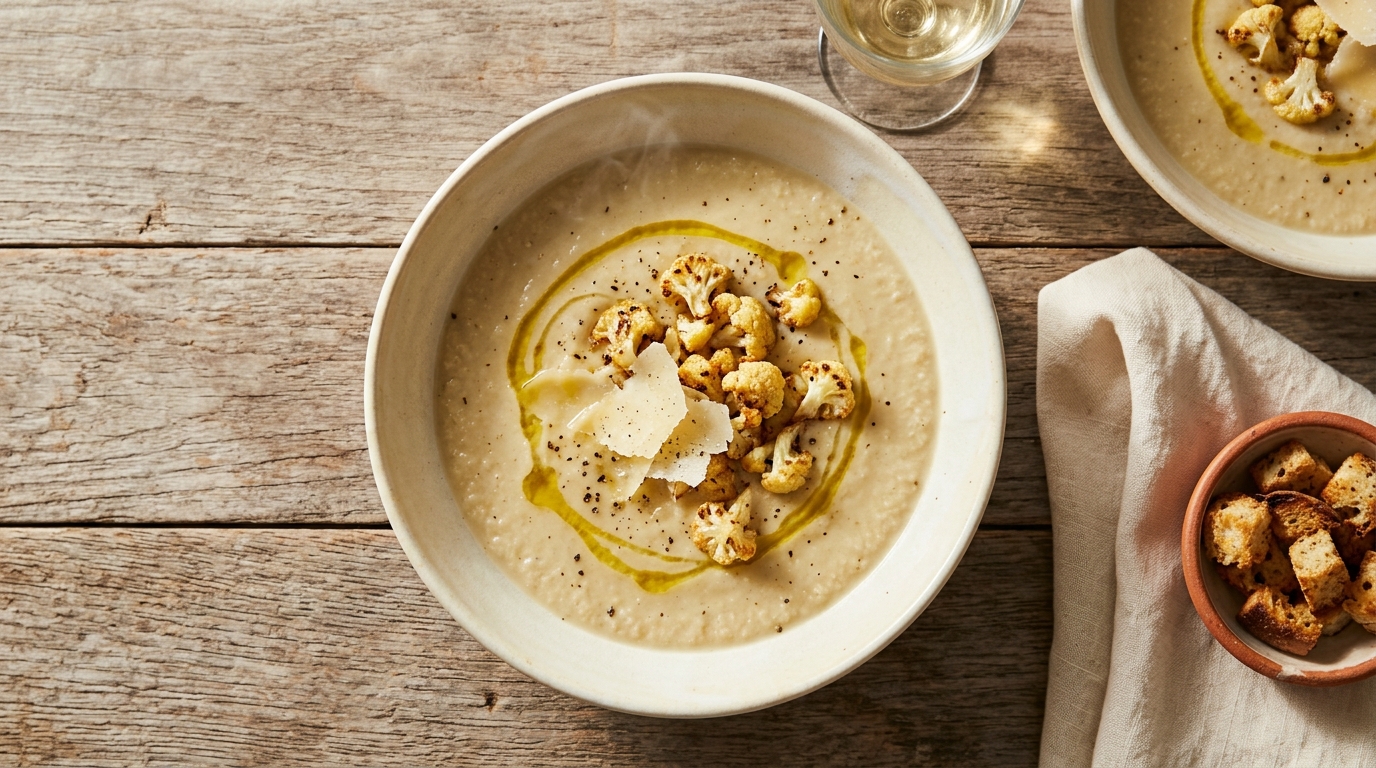
Finish each bowl with a swirl of best-quality extra virgin olive oil (a good Australian one from Cobram Estate or a single-estate Italian if you have splashed out), a generous handful of the reserved roasted florets, a fresh grating of parmesan and a few cracks of black pepper. The garnish is what makes the soup look like a soup that someone cooked rather than a soup that came out of a tin.
Two things that go wrong
Soup is bland and tastes like wet vegetable
You did not roast the cauliflower hard enough, or you under-salted, or both. Roast the cauliflower at 220°C until the edges are properly amber-brown; salt generously at the start and again at the end. If the soup is already made and bland, add a tablespoon of butter, an extra grating of parmesan and a teaspoon of soy sauce. The soy will not taste like soy; it will fortify the savouriness.
Soup is grainy or split
You added the cream while the soup was boiling, or you added the parmesan to a too-hot soup. Take the soup off the heat, blend hard with a stick blender for 30 seconds, then strain through a fine sieve. The texture should be velvet-smooth. To prevent next time: cream goes in off the heat, parmesan goes in off the heat, blender does the work.
Variations worth knowing
Cauliflower and blue cheese soup
Replace half the parmesan with crumbled blue cheese (Roaring Forties Blue or Berry’s Creek Riverine). Stir in off the heat. The soup becomes funky, intense, the kind of dish you serve as a starter at a small dinner party where everyone is paying attention. Garnish with toasted walnuts.
Curried cauliflower soup
Add a tablespoon of curry powder and a teaspoon of grated fresh ginger when sweating the onion. Replace 200ml of the stock with coconut milk. Skip the parmesan; finish with fresh coriander and a squeeze of lime. The Sri Lankan-leaning version, the dish that eats well with naan.
Brown-butter and hazelnut cauliflower soup
Brown 60g of butter in a small pan until it smells nutty, drizzle over each bowl as the finishing oil instead of olive oil. Top with a tablespoon of toasted chopped hazelnuts. The dish becomes deeply nutty, slightly French, the version for an autumn-into-winter Sunday lunch.
Leftovers and make ahead
Refrigerate covered for up to four days, or freeze for three months. The texture will thicken in the fridge as the cream sets; thin with a splash of stock or hot water when reheating. Reheat gently on the stove, stirring constantly, until just hot through. Do not microwave to boiling; the cream will split and you will have a slightly grainy soup that requires re-blending.
Day-two soup is also extraordinary as a sauce for pasta. Reduce 200ml of leftover soup over high heat for five minutes until thickened, toss through cooked pappardelle with a handful of toasted breadcrumbs and a fresh grating of parmesan. The dish stops being soup and starts being a quiet vegetable carbonara. Eat at the kitchen counter, alone, while the kettle boils.
The recipe
[fd-wprm-placeholder]
Ingredients
Method
- Preheat oven to 220°C fan-forced. Toss the cauliflower florets with 3 tbsp of the olive oil and a generous pinch of salt. Spread in a single layer on a baking tray. Add the cauliflower leaves separately.
- Roast for 25 minutes, turning halfway, until deeply browned at the edges. Reserve a third of the florets and the roasted leaves for garnish.
- Heat the butter and remaining 1 tbsp olive oil in a large heavy pot over medium-low heat. Sweat the onion 8 minutes until soft. Add the garlic, cook 1 minute.
- Add the remaining roasted cauliflower and the stock. Bring to a simmer; cook 10 minutes.
- Take the pot off the heat. Blend with a stick blender until silky smooth (or transfer to a high-speed blender in batches).
- Return to low heat. Stir in the cream and the parmesan off the heat (or with the heat very low). Add the nutmeg, season generously.
- Ladle into warm bowls. Top each with a scatter of the reserved roasted florets, a few roasted leaves, a swirl of best-quality olive oil, an extra grating of parmesan, and a few cracks of black pepper. Croutons on the side if you like.