
Why you are cooking this tonight
This is the curry I make when the week is winning and I have forty minutes to rescue Wednesday. It’s the curry I make when I’ve pulled prawns out of the freezer and realised at 6:12pm that prawns alone are not dinner. It’s the curry I make when someone says they want “something light and fresh” and I want to say yes but also feed them properly.
Authentic Thai green curry has about 40 ingredients in the paste and a father who’s been making it for 30 years. The one we’re making tonight has a good jar of paste, a pile of aromatics to lift it, and the respect to spend ten minutes frying the paste in coconut cream before anything else gets added. That frying step is the thing. It is what separates a pale, sad, watery curry from a deep, glossy, almost-shiny one that tastes like it came out of a proper kitchen.
Do the frying step. Please. The rest of the recipe is just not turning the heat down too early.
What you need
600 g boneless skinless chicken thighs, cut into bite-sized chunks. Breast dries out. Thigh stays silky. Plus thigh is cheaper and tastes better. This is one of those cases where the cheaper cut is also the right cut.
100 g green curry paste. The best jar you can afford, Asian grocer if possible. Mae Ploy is the pick. Supermarket brands are mostly salty underperforming sludge. Ten dollars for a jar that will do six dinners is the right spend.
400 ml full-fat coconut milk. Full fat. No reduced-fat. Reduced-fat coconut milk is a crime against this dish. Ayam, Pandaroo, Trident, any of them.
160 ml coconut cream. Cracks to make the paste shine. If your coconut milk has a thick cream layer at the top of the tin, you can skim that off and use it in place of coconut cream. If it’s a well-blended tin, buy a separate small can of cream.
2 tbsp fish sauce. Squid brand if you want the authentic answer.
1 tbsp palm sugar or soft brown sugar. Palm sugar is at the Asian grocer for $3 and lasts forever.
5 kaffir lime leaves, torn or chopped into slivers. If you can’t find fresh, frozen is fine. If you can’t find frozen, skip them and live with the gap. No substitute.
1 thumb of fresh ginger or galangal, peeled and sliced into fine coins.
2 lemongrass stalks, bashed hard with the back of a knife, ends trimmed, chopped into 5 cm logs.
2 fresh long green chillies, halved lengthways, seeds out if you want to dial the heat down.
1 small eggplant (ideally Thai pea or apple eggplant, in practice a slim Japanese eggplant), cut into half-moons.
1 small handful of snake beans or green beans, cut into 4 cm batons.
1 bunch of Thai basil leaves, picked. If you can’t find Thai basil, regular Italian basil is a pale but acceptable stand-in. Mint is not.
1 lime for wedges.
Jasmine rice, 1 cup dry for four people, cooked plain.
How to cook it
Step 1. Rice first
Rinse the rice in a sieve until the water runs clear. One cup rice, 1.5 cups cold water, tight lid. High heat to boil, lowest heat to simmer for 12 minutes. Off the heat, lid on, 10 more minutes. Fluff with a fork. Do this first and leave it alone.
Step 2. Crack the coconut cream
Heavy-based wok or wide pan, medium-high heat. Spoon the coconut cream in (not the whole tin of coconut milk, just the cream). Let it sit and hiss. After about three minutes it will separate: a layer of clear coconut oil rising to the top, and the milk solids catching on the pan. This is the most important moment in the dish. Do not skip it.
Step 3. Fry the paste
In with the green curry paste. Stir through the cracked coconut cream. Keep the heat on medium-high. Fry the paste for a good five to seven minutes, stirring often so it doesn’t burn. The colour will deepen from a light green to a darker, oilier, glossier green. The smell will change from “spice” to “actual food”. When you can see coconut oil pooling around the paste, it’s done.
Step 4. Aromatics
Ginger, lemongrass, half the lime leaves. Thirty seconds. The kitchen now smells like a good night out.
Step 5. Chicken
In with the chicken. Stir to coat every piece in the paste. Three minutes, until the outside has gone opaque. Don’t worry about cooking it through yet.
Step 6. Coconut milk and simmer
Pour in the coconut milk. Fish sauce, sugar. Bring to a gentle simmer. Drop in the eggplant. Cook, medium heat, 10 minutes, stirring occasionally. The chicken finishes, the eggplant collapses, the sauce tightens.
Step 7. Beans and green chillies
Beans and green chillies in for the last three minutes. Still bright green, still a slight bite.
Step 8. Finish
Off the heat. Most of the Thai basil in, stir through just to wilt. Taste. Fish sauce if it’s flat, sugar if it’s too salty, lime juice if it needs a lift. The balance you are looking for is salty, sweet, a little sharp, with the spice in the background, not the foreground.
Step 9. Serve
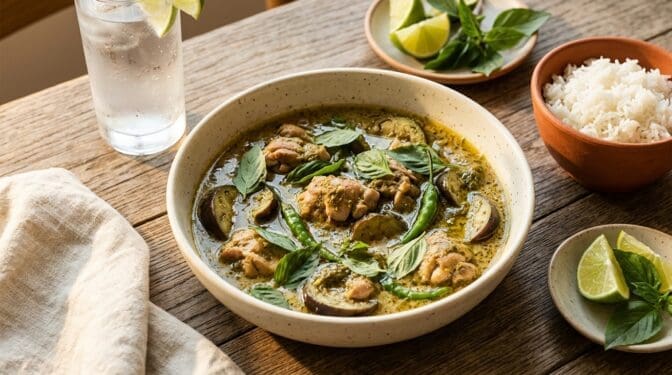
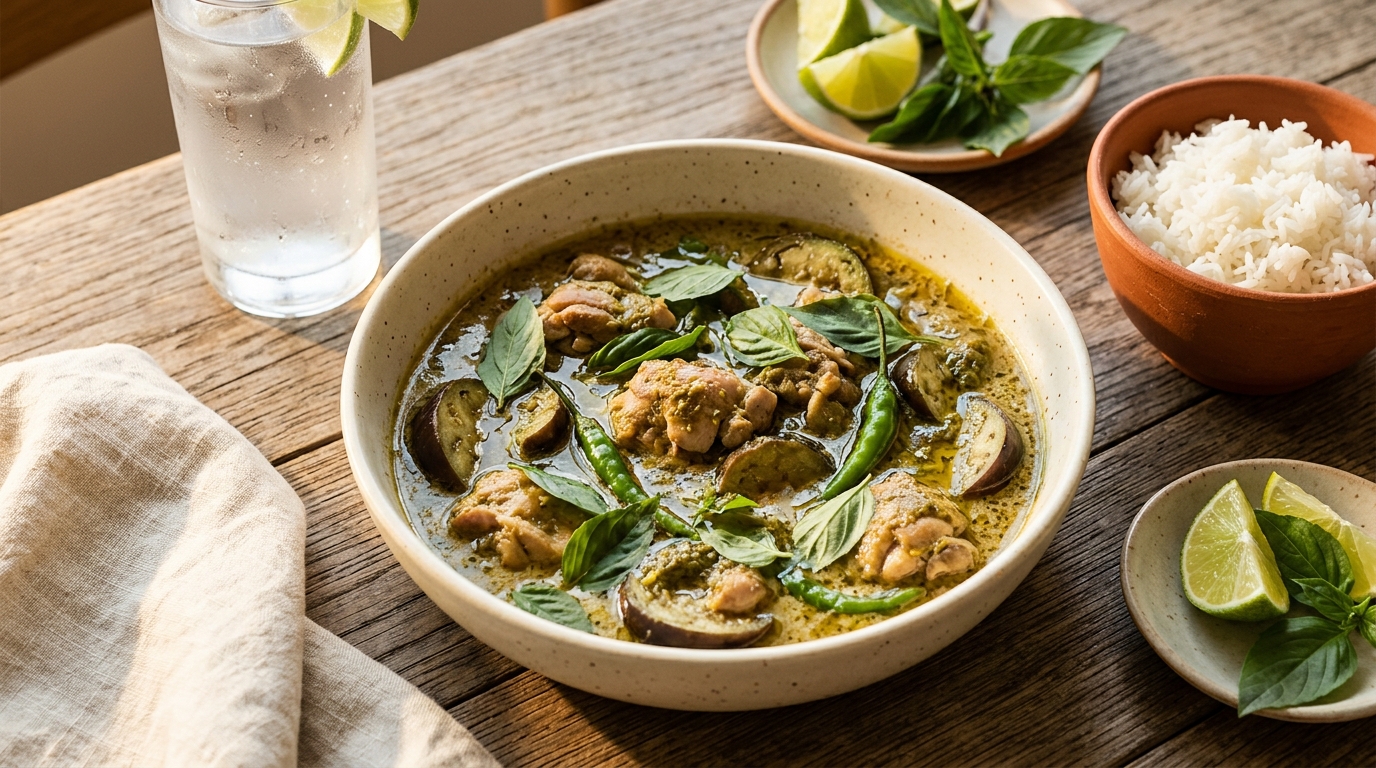
Big bowls. Rice on one side, curry on top or beside. Remaining Thai basil scattered over. Lime wedge. A spoon. A bowl of chilli sauce (sriracha or a Thai chilli vinegar) on the table for anyone who wants more heat.
What to pour with it
 Wine / beer to buy
Off-dry Clare Valley Riesling
Pewsey Vale, Jim Barry Lodge Hill, Grosset Polish Hill if you’re feeling rich. The tiny kiss of residual sugar calms the chilli, the sharp acid cuts through the coconut, and the citrus character echoes the lime leaves. This pairing is so good I could cry.
Make this drinkA gin and tonic
Botanically, it’s the right neighbourhood. Tonic’s quinine cuts the richness, juniper plays with the lemongrass. Four Pillars Olive Leaf Gin is a surprisingly perfect match.
Read the recipe →Wine / beer to buySingha or Chang beer
Cold. Unfussy. The drink you’d order in Chiang Mai. Zero friction, total correctness.
Wine / beer to buyA lychee martini
if you want a cocktail that matches the energy. Vodka, lychee liqueur, a splash of lime, a lychee in the glass. Comfortably daggy, completely correct.
Two things that go wrong
The sauce is watery and pale. You didn’t crack the coconut cream and fry the paste long enough. Next time, more patience at the start. Today, crank the heat for the last five minutes, uncovered, and reduce the liquid. Stir in an extra tablespoon of paste if you still have some.
It’s way too hot. Your paste was fierce. A big spoon of coconut cream stirred in cools it down. A squeeze of lime helps. Or serve with more rice and the world becomes a kinder place.
Variations worth knowing
Prawns instead of chicken
Use 500 g green prawns, peeled, deveined. Add at the last five minutes, not the chicken stage. Pink and curled equals done.
Tofu and mushroom
Firm tofu cubed and pan-fried golden, plus a big handful of mixed mushrooms. Add at the chicken stage. Vegetarian, very good.
Red curry
Same method, swap to red curry paste, swap the green chillies for Thai basil or swap to coriander. Red is sweeter, deeper, often goes better with beef and duck.
Leftover plan
Next-day Thai green curry is a triumph. The paste has infused, the eggplant has surrendered. Warm slowly with a splash of water, serve with fresh rice. Or: turn it into a soup by adding another 400 ml coconut milk and a squeeze of lime, top with crispy shallots and eat it out of a mug on the couch.
Thai Green Curry
Ingredients
Method
- Open the tin of coconut milk. Scoop the thick cream from the top into a wok or deep frypan, leaving the thinner milk behind.
- Heat the coconut cream over medium-high heat until it splits and the oil comes out, about 3 minutes.
- Add curry paste. Fry hard for 2 to 3 minutes until fragrant and darkened. This step is non-negotiable.
- Add chicken and cook until just sealed, 3 minutes.
- Pour in the remaining coconut milk, stock, kaffir lime leaves, fish sauce and sugar. Simmer for 10 minutes.
- Add eggplant and beans. Simmer for 5 to 7 minutes until tender.
- Stir in lime juice. Taste and adjust fish sauce or sugar.
- Scatter chilli and thai basil over the top. Serve with jasmine rice.