
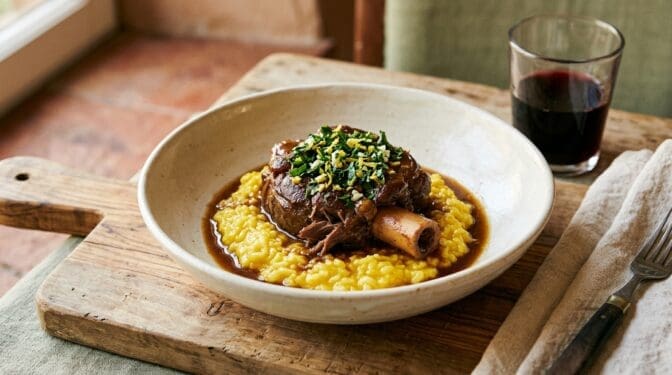
Veal shanks braised slow until the bone marrow surrenders, served on a saffron risotto the colour of a Tuscan postcard you swore you would not buy.
Why you should cook this
The Milanese version of osso buco is the only osso buco worth the four hours of your life it is going to ask for. The veal shank goes into a sealed pot with mirepoix, white wine, stock and tomato, comes out tender enough to eat with a spoon, and sits on a saffron risotto the colour of a polite emergency. The saffron risotto is the whole point. Without it you are eating a stew, which is a fine dish but a different one, and we are not making that dish today. We are making the dish where the bone marrow at the centre of the shank is treated as the prize, gets fished out at the table with a small spoon, and gets spread on a piece of bread by whoever is paying the most attention.
This is project cooking, in the same way assembling Ikea is. Set aside a Saturday afternoon. Open a glass of something cheap and Italian to drink while the kitchen smells like a Milanese nonna’s kitchen at three in the afternoon, which is to say like braising meat, soft onion, white wine reducing and a small amount of dignity. Stir the risotto when the timer says, not when the dog wants attention. The whole thing falls apart if the rice is rushed.
Use a bone-in veal shank cut about 4cm thick from a real butcher who can tell you what veal it is. The shank from Coles in a foam tray is technically veal and technically a shank and is in every other respect a different animal.
What to drink with it
A Barbera d’Alba from the Piedmont. The acidity cuts the marrow fat, the cherry fruit lifts the saffron, and the whole dinner suddenly stops being a project and starts being an event. Spend $25 to $35 at a bottle shop with a serious Italian section. Vinomofo runs a Pio Cesare Barbera every couple of months for around $32. If a Barbera is not on the shelf, a Chianti Classico does the same job in a slightly more crowded suit.
Recipe
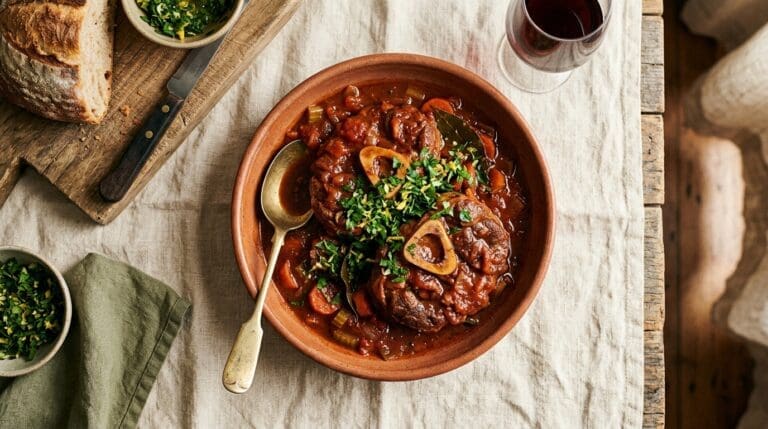
Slow Cooker Osso Buco
The Milanese masterclass, simplified. Why you should cook this The Milanese masterclass made hands-off. Four veal shanks, each tied with kitchen twine so they hold their shape through…
Read the recipe →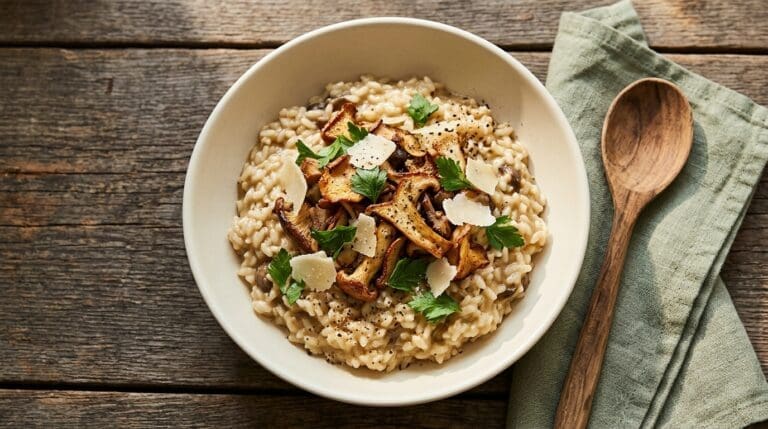
Recipe · Dinner
Wild mushroom risotto without the panic
Risotto has a reputation for being fussy and it does not deserve it. Thirty-five minutes of mostly standing and stirring while you sip a glass of white wine.…
Read the recipe →
Dolin Rouge Sweet Vermouth
Dolin Rouge is the lighter, more alpine cousin of Carpano Antica. Made in Chambery with mountain herbs, wormwood, and a gentler sweetness, it gives you a Negroni or…
Read more →Notes from the kitchen
Tie each shank around the equator with butcher’s twine. The connective tissue holds the meat to the bone for the first hour and lets go in the third, which is when the shank tries to fall apart in the pot and look untidy on the plate. The twine keeps everything together until you cut it off at service. Brown the shanks hard on both sides before you add anything liquid; this is the colour and the depth and there is no shortcut. Use a saffron from a Spanish or Iranian source, not the supermarket plastic tube of yellow string nobody can quite explain. Steep the saffron in a tablespoon of warm stock for ten minutes before adding to the risotto. The colour should look like the inside of a marigold, not like a turmeric latte. Finish the risotto with cold butter and grated parmigiano-reggiano off the heat, beating the rice until it is glossy and almost loose. The Italians call this the mantecatura. We call it “the bit at the end where you pretend you knew what you were doing.”
Two things that go wrong
Risotto goes gluggy and pasty
You stopped stirring, or you added all the stock at once. Risotto is a relationship. Add stock a ladle at a time, stir constantly, and the rice will release its starch on schedule. Walk away and the rice walks away too.
Shanks fall apart on the spoon and look like a stew
You braised too hot. The oven wants 150°C, no higher. Higher and the meat ruptures before the connective tissue softens, and you end up with stringy fibres in liquid instead of a clean piece of falling-off-the-bone meat.
Variations worth knowing
Lamb shank version
Swap the veal shanks for bone-in lamb shanks. Same braise, different animal, ten percent less marrow drama.
Without the saffron
Serve over soft polenta with parmigiano-reggiano. The polenta version is the colder-weather take and is excellent in late June.
Pressure cooker
Sear the shanks, then 50 minutes at high pressure with the braising liquid. Risotto on the stove while the shanks rest. Whole thing in about an hour and a half if you have to.
Leftovers and make ahead
The braised shanks improve overnight in the fridge, the way most slow-cooked things do. The marrow starts to set into the sauce, which is wonderful and slightly inconvenient and worth it. Reheat in a covered pan over low heat with a splash of stock to loosen. The risotto does not keep. Ever. Risotto is a thing you eat in the moment or you do not eat at all. If you have leftover risotto the next day, fry it into arancini and tell nobody that is what you intended all along.
The recipe
[fd-wprm-placeholder]
Ingredients
Method
- Preheat oven to 150°C. Pat the shanks dry, season with salt and pepper.
- Heat oil and 30g butter in a heavy oven-safe pot over high. Brown the shanks hard on both sides, about 4 minutes each side. Set aside.
- Reduce heat to medium. Add onion, carrot, celery and remaining butter. Cook 8 minutes until soft. Add garlic, cook 1 minute.
- Pour in wine, scrape the base, reduce by half. Add tomatoes, stock, thyme, bay leaf.
- Return shanks to the pot, ensuring they are mostly submerged. Cover and transfer to the oven for 2.5 to 3 hours, until the meat falls from the bone at a fork's suggestion.
- Steep saffron in 2 tablespoons warm stock for 10 minutes.
- In a wide pan, melt 30g butter over medium-low. Sweat the onion 5 minutes.
- Add rice, stir 2 minutes until translucent at the edges. Add wine, stir until absorbed.
- Add stock a ladleful at a time, stirring constantly, waiting for each addition to absorb before adding the next. Halfway through, stir in the saffron stock.
- After 18 to 20 minutes, the rice should be al dente and creamy. Off the heat, beat in the remaining butter and parmigiano. Cover and rest 2 minutes.
- Combine gremolata ingredients.
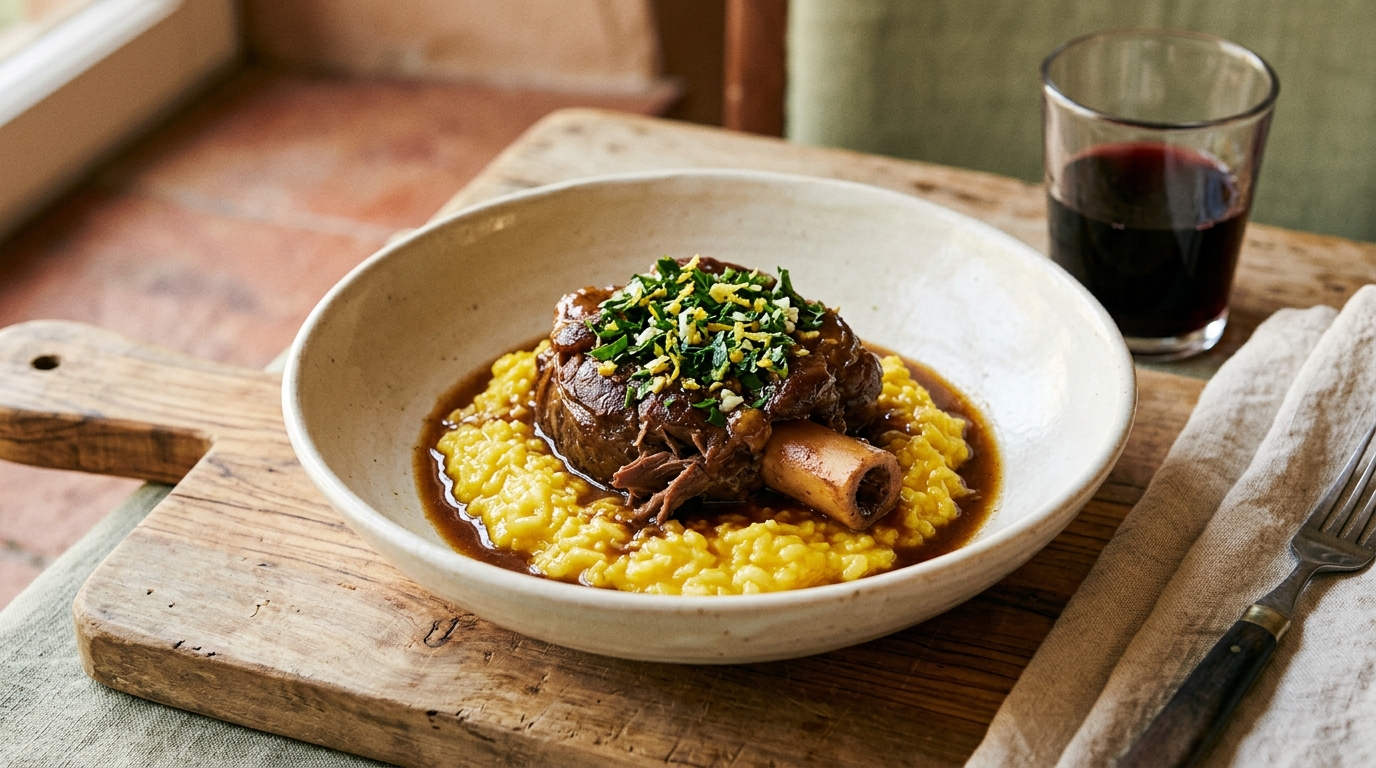
- Spoon risotto onto warm plates. Top each with a shank and ladle the braising sauce around. Scatter gremolata over.
- Serve immediately, with a small spoon for the marrow.