

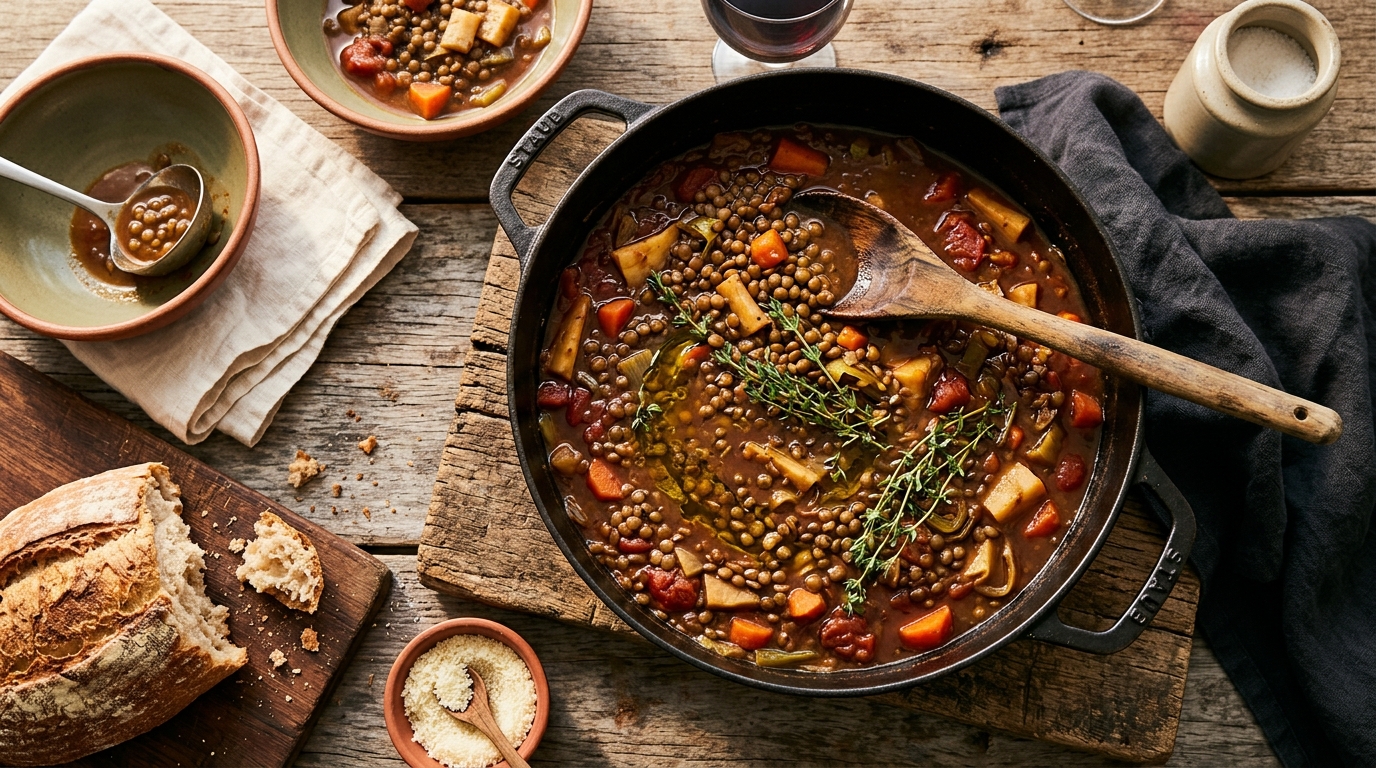
French puy lentils, root vegetables, parmesan rind, fresh thyme. One pot, ninety minutes, the dinner that proves vegetarian comfort food does not need to apologise.
Why you should cook this
The first lentil stew I cooked from scratch was an overconfident mid-twenties experiment based on a Yotam Ottolenghi article I had read on a train, in which I substituted four ingredients I did not have for four ingredients I did, and the result tasted like a small soup that had been deeply hurt by a kitchen incident. My flatmate ate it without comment and went out for chips. That is not the dish we are cooking today.
This stew is the opposite of that experiment: a slow build of root vegetables and lentils in a stock fortified with a parmesan rind and a couple of bay leaves, finished with fresh thyme and a swirl of good olive oil. It is hearty without being heavy, vegetarian without being apologetic, and the kind of dinner that makes a meat-eater pause halfway through and ask what cut of beef this is. The answer is: there is no beef. The depth comes from the parmesan rind, which is the secret ingredient that turns vegetable stock into something that tastes like a butcher’s shop ran a slow campaign of seduction against an Italian deli.
Use French puy lentils. Brown lentils will work but lose their structure and turn the stew muddy. Red lentils will collapse into a soup. Puy lentils hold their shape, have a slight peppery quality, and absorb the stock without going to mush. Available at any IGA in the legume aisle, $8 a bag, lasts for six months. Worth the upgrade. The other lentil that will work is castelluccio (small, brown, Italian), which is harder to find but slightly more flavourful.
The parmesan rind is the trick. Save the rinds from your weekly parmesan in a small bag in the freezer; they keep for six months and add a depth of umami to any soup, stock or stew that you cannot fake any other way. If you do not have a rind, a tablespoon of soy sauce or a teaspoon of marmite added at the simmering stage gives a similar effect. Both are vegetarian. Both are the cheat’s version. The rind is the original.
What to drink with it
The stew wants a medium-bodied red with some earthiness. A McLaren Vale grenache (Yangarra Old Vine at $25 from Dan Murphy’s) is the everyday pour; a Beaujolais (Marcel Lapierre Morgon at $55) is the upgrade. Both have the fruit-forward acidity that cuts through the lentil starch and the soft tannin that does not overwhelm the dish. If you want a white, a richer Hunter Valley semillon with some age (Tyrrell’s HVD aged six years, around $30) does the job; the lemon-lanolin character lifts the stew without smothering it.

Recipe · Dinner
Winter Vegetable Soup
Three hours of slow extraction, an old parmesan rind, a few cheap vegetables. The soup the Italians have been quietly winning at since the fourteenth century. Why you…
Read the recipe →
Recipe · Dinner
Pasta e Fagioli
Pasta, beans, soffritto, tomato, a parmesan rind simmered in for two hours. The Italian peasant soup that is somehow worth more than half the things you have paid…
Read the recipe →
Notes from the kitchen
Sweat the aromatics first. Onion, leek, carrot, celery, finely diced, in olive oil and a knob of butter, on low heat for ten minutes until everything has softened and the onion has gone translucent and slightly sweet. This is the base of every stew that has ever been worth eating. Skip the sweat and the dish tastes like it was assembled rather than cooked. Add the garlic at the end of the sweat (it burns faster than the rest), then the tomato paste for two minutes until it darkens.
Deglaze with a splash of red wine, scrape the fond, reduce by half. Add the lentils (rinsed, picked over for any small stones), the stock, the parmesan rind, a few bay leaves and a handful of whole thyme sprigs. Bring to a simmer, cover, drop the heat to the lowest possible flame, cook for 45 minutes until the lentils are tender but still hold their shape. Add the parsnip and the swede in the final 25 minutes (they cook faster than the lentils and you do not want them dissolving into the stew). Adjust seasoning at the end; lentils need salt, generously.
Finish with fresh thyme leaves stripped from their stems, a swirl of best-quality olive oil and a fresh grating of parmesan over each bowl. The parmesan at the end is the reward. The olive oil is the gloss. Crusty bread on the side, ideally a sourdough you tore with your hands rather than sliced. Wine. A second helping. The dinner is done.
Two things that go wrong
Stew is bland and tastes like vegetable water
You forgot the parmesan rind, or you under-salted, or both. Fish out a bay leaf, add a tablespoon of soy sauce or a teaspoon of marmite to fortify the umami, then taste for salt. Lentils need a generous hand. The stew should taste like a hug, not a polite suggestion.
Lentils are mushy and the stew has turned to soup
Cooked too long or used the wrong lentils. Puy lentils hold for around 50 minutes; brown lentils break down at 40. Switch lentils next time. For now: stir gently, do not smash, accept that tonight’s dinner is a thicker stew. Serve with extra olive oil to disguise. Nobody will mind.
Variations worth knowing
Smoky lentil stew
Add a teaspoon of smoked paprika and a chopped chorizo at the start (skip if vegetarian). The dish becomes Spanish-coded; tastes like a dish you ate once in a tapas bar in Lygon Street. Serve with a squeeze of lemon at the end.
Coconut and curry lentil stew
Add a tablespoon of curry powder and a tin of coconut milk in place of half the stock. Keep the parmesan rind out (it fights the coconut). Finish with fresh coriander and a squeeze of lime. The Sri Lankan-leaning version, the dish for a wet July night.
Tuscan lentil stew
Add a chopped bunch of cavolo nero (Tuscan kale) in the final ten minutes, plus a tin of cannellini beans. Serve over a slice of toasted sourdough rubbed with garlic, drizzled with olive oil. The peasant-Italian version, the dish that pairs with a chianti and a candle.
Leftovers and make ahead
Better the next day. Better the day after that. The stew thickens in the fridge as the lentils continue to absorb stock; thin with a splash of water or stock when reheating. Refrigerate covered for up to five days, or freeze for three months. Reheat gently on the stove, lid on, until just hot through. Add a fresh swirl of olive oil and a fresh grating of parmesan at the table to restore the gloss.
Day-three stew is also the best base for a lentil soup. Add an extra cup of stock, blitz half with a stick blender, leave the rest chunky. Top with a poached egg and a slice of bacon. The dish stops being stew and starts being something else. Eat at the kitchen counter, alone, while the kettle boils.
The recipe
[fd-wprm-placeholder]
Ingredients
Method
- Heat olive oil and butter in a large heavy pot over medium-low heat. Add onion, leek, carrot and celery. Cook gently for 10 minutes until soft and translucent.
- Add the garlic, cook 1 minute. Stir in the tomato paste, cook 2 minutes until darkened.
- Pour in the red wine, scraping the bottom of the pot. Reduce by half, about 3 minutes.
- Add the lentils, stock, parmesan rind, bay leaves and thyme sprigs. Bring to a simmer.
- Cover, reduce heat to lowest possible flame, cook for 25 minutes.
- Add the parsnip and swede. Continue to cook, partially covered, for another 25 minutes until the lentils are tender but hold shape and the vegetables are soft.
- Discard bay leaves, thyme stems and parmesan rind. Season generously with salt and pepper.
- Ladle into warm bowls. Top each with a swirl of olive oil, fresh thyme leaves and a generous grating of parmesan. Crusty bread on the side.