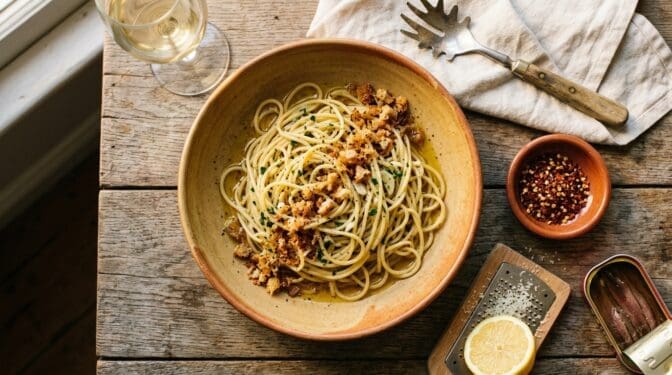
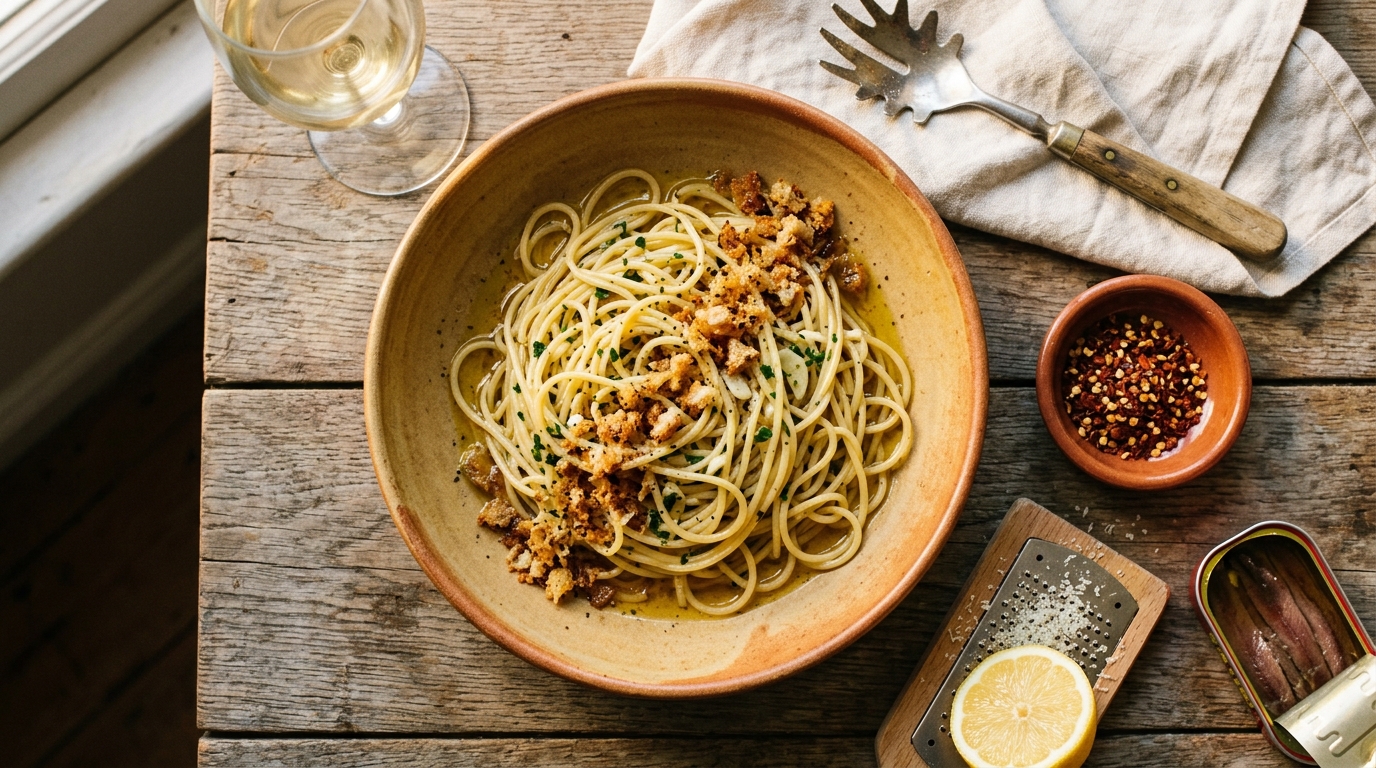
Spaghetti aglio e olio with anchovies dissolved into the oil. Five ingredients. Twelve minutes. The Italian-pantry classic that explains why the Italians win at dinner.
Why you should cook this
Spaghetti with anchovy and garlic is the dish I cook when I do not feel like cooking. It is the dish I cook when I get home at 9.40pm on a Tuesday after a meeting that ran long and a train that ran late, and the choice is between this and ordering UberEats from the Vietnamese place that always disappoints. It is the dish that takes twelve minutes from the moment the kettle goes on to the moment the bowl is in front of me, and it is the dish that makes me wonder, every single time, why I would ever cook anything else. The Italians have known this for two hundred years. The rest of us are slowly catching up.
The technique is to dissolve the anchovies into the warm garlic oil before the pasta goes in. The anchovies do not stay as anchovies. They become a savoury liquid base that you cannot pick out as a flavour, only as a kind of underlying depth. Your guests will eat the pasta and ask what makes it taste so much better than the version they make at home, and the answer is: anchovies, you have just been politely declining the secret ingredient your whole life.* The dish without the anchovies is fine. The dish with the anchovies is what the Italians have been laughing at us about.
(*“I don’t like anchovies” is a sentence said exclusively by people who have only encountered anchovies as a pizza topping at a Pizza Hut in 2003. The anchovy on a Pizza Hut pizza is a sad small fish that has had a hard life. The anchovy in a tin of Ortiz at 22 Marrickville Metro is a different creature. Try it dissolved in oil before you decide.)
Use the best anchovies you can afford. The Ortiz tin (the white ones in olive oil from the Marrickville Metro deli aisle) at $18 a tin gives you twelve fillets and a flavour profile that justifies the price. The cheap supermarket Sirena anchovies at $4 a tin work as a starting point but lack the depth. The Spanish Don Bocarte tin at $24 is the upgrade. Avoid the brown ones in vinegar (boquerones); they are a different fish for a different dish.
The pasta has to be the right pasta. Spaghetti, dried not fresh, ideally bronze-die from a quality Italian brand (De Cecco at $4 a packet from Coles, Rummo at $5 from a deli, Setaro at $9 from the better Italian shops). Bronze-die pasta has a rougher surface that holds sauce; the smooth supermarket spaghetti slides off and you end up with naked noodles in a pool of oil. The pasta is the dish; do not cheap out on the pasta.
What to drink with it
A crisp Italian white. A Vermentino or a Falanghina or a Greco di Tufo. The acidity matches the salt; the citrus echoes the lemon-and-anchovy register. Antinori’s Bianco at $25 from Dan Murphy’s is the everyday pour. An Australian alternative is a Hunter Valley Semillon (Tyrrell’s Vat 1 at $50 if you want to splash, McGuigan Bin 9000 at $20 if you don’t), which has the same acid spine as a Vermentino. Avoid red wine; the lemon and the chilli will make a Shiraz taste sour.
Recipe · Dinner
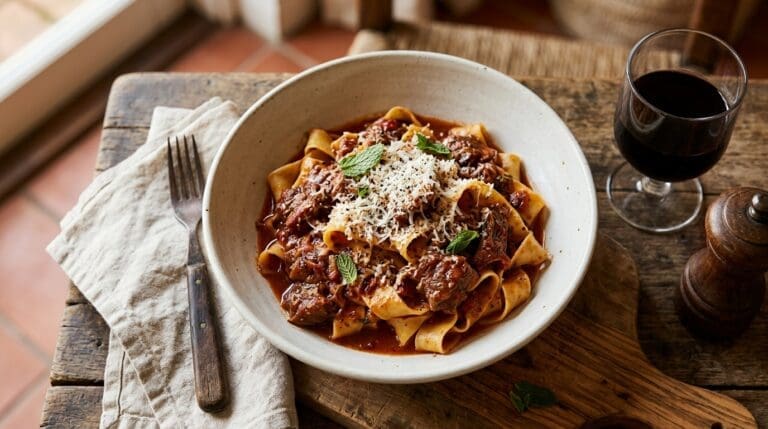
Lamb Ragu with Pappardelle
Slow-cooked lamb shoulder, pulled into ragu, tossed through wide ribbons of pappardelle. Beef ragu’s rangy older cousin who left town for a while. Why you should cook this…
Read the recipe →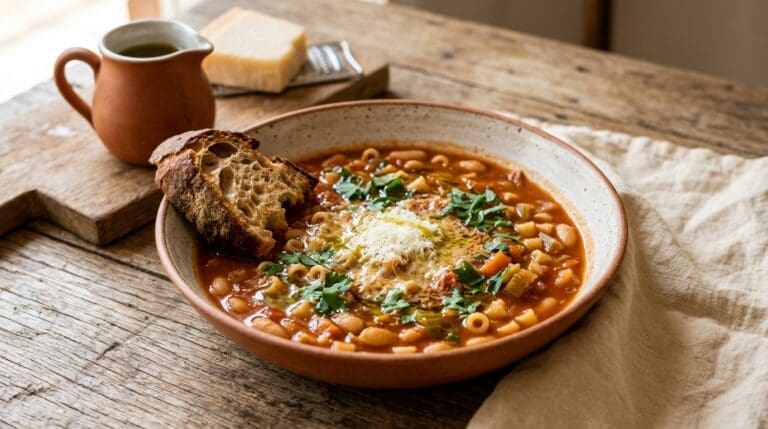
Recipe · Dinner
Pasta e Fagioli
Pasta, beans, soffritto, tomato, a parmesan rind simmered in for two hours. The Italian peasant soup that is somehow worth more than half the things you have paid…
Read the recipe →
Notes from the kitchen
Salt the pasta water like you mean it. Fifty grams per litre is the Italian standard; the water should taste like the sea, not like a polite gesture toward seasoning. Bring a large pot of well-salted water to a rolling boil, slip in the spaghetti, stir once to stop it sticking, set a timer for two minutes less than the packet instructions (you finish the pasta in the sauce, where it absorbs flavour and continues to cook). Reserve a cup of the pasta water before draining; the starchy water is the second secret ingredient.
While the pasta cooks, build the sauce. Pour 80ml of good extra virgin olive oil into a wide pan over the lowest gas heat you have. Slip in four fat cloves of garlic, sliced thin lengthwise (not crushed; sliced garlic infuses gently, crushed garlic burns). Add four to six anchovy fillets and a generous pinch of dried chilli flakes. Stir gently with a wooden spoon, mashing the anchovies into the warm oil with the back of the spoon. The anchovies dissolve into the oil within two minutes; the garlic should soften and turn pale gold without going brown. Brown garlic is bitter garlic. Keep the heat low.
When the pasta is two minutes off al dente, lift it directly from the water into the sauce pan with a pair of tongs (do not drain into a colander; you want the wet noodles to bring a little water with them). Toss the pasta through the warm garlic oil over medium heat. Add a generous splash of the reserved pasta water (half a cup is the right starting amount); the starchy water emulsifies with the oil into a creamy glossy sauce that clings to the noodles. Toss for a minute or two until the sauce coats every strand. Off the heat, fold through a fistful of finely chopped flat-leaf parsley and a squeeze of lemon. Plate. Top with toasted breadcrumbs (panko fried in olive oil with a pinch of chilli) and a drift of finely grated parmesan.
Two things that go wrong
Sauce is greasy and sits in a pool at the bottom of the bowl
You did not add the pasta water, or you added too little. The starchy water emulsifies the oil into a creamy clinging sauce. Add another quarter-cup of pasta water to the pan, toss vigorously over medium heat for another minute. The oil should disappear into the sauce; if it doesn’t, the heat is too low; turn it up briefly and toss harder.
Garlic has burnt and the oil tastes bitter
Heat was too high. Burnt garlic is unrecoverable; pour out the oil, wipe the pan, start again with fresh oil and fresh garlic. Garlic infuses cleanly only at low heat (around 100°C), where the oil is shimmering but not smoking. If the oil starts smoking, take the pan off the heat for 30 seconds before continuing.
Variations worth knowing
Spaghetti puttanesca
Add a tablespoon of capers, six pitted black olives (Sicilian or Kalamata), and a tin of crushed tomatoes to the garlic oil. Cook for 12 minutes until the sauce thickens. The Neapolitan classic that became the cookbook-sales hit of 1985.
Spaghetti with anchovy and broccolini
Blanch a bunch of broccolini in the pasta water for 2 minutes before adding the spaghetti. Lift out, chop, fold through the finished pasta. The dish becomes greener, slightly more substantial, the version for a Sunday lunch instead of a Tuesday late-night.
Spaghetti with anchovy and burrata (the showy one)
Plate the pasta in shallow bowls. Tear a 200g ball of fresh burrata over the top of each. Crack pepper. The dish becomes the kind of pasta you put on Instagram. The burrata softens the bite of the anchovy and the chilli.
Leftovers and make ahead
Spaghetti aglio e olio is, with great regret, a dish that does not reheat well. The pasta soaks up the oil overnight and the noodles go soft and oily on day two. If you have leftovers, cold spaghetti is a real food (an Italian breakfast tradition); fold a fistful into a clean bowl with a splash of fresh oil, a squeeze of lemon, a fresh grating of parmesan. Eat at the kitchen counter for breakfast on a Sunday morning, standing up, while the kettle boils.
Leftover anchovy oil from the tin (and you will have some) keeps in a sealed jar in the fridge for two weeks. Drizzle over a tomato salad, brush onto a piece of toasted sourdough, fold into a pasta sauce next week. The oil is half the value of the tin; do not throw it out. Leftover toasted breadcrumbs keep in a sealed container at room temperature for a week and become the topping for the next round of any pasta dish that wants crunch.
The recipe
[fd-wprm-placeholder]
Ingredients
Method
- Bring a large pot of generously salted water to a rolling boil. Slip in the spaghetti, stir once. Set a timer for 2 minutes less than the packet instructions.
- Meanwhile, toast the panko breadcrumbs in 1 tbsp of the olive oil in a small pan over medium heat for 3 minutes until golden. Set aside.
- In a wide pan over the lowest gas heat, warm the remaining olive oil with the sliced garlic, anchovies and chilli flakes. Stir gently, mashing the anchovies into the oil. Cook 2 to 3 minutes until the garlic is pale gold and the anchovies have dissolved.
- When the pasta has 2 minutes left, lift it directly from the water into the sauce pan with tongs. Add a generous half-cup of the pasta water.
- Toss over medium heat for 1 to 2 minutes until the sauce emulsifies into a creamy gloss that clings to the noodles. Add more pasta water if it looks dry.
- Off the heat, fold through the chopped parsley and a generous squeeze of lemon. Taste; adjust salt and chilli.
- Divide between bowls. Top with the toasted breadcrumbs and a drift of grated parmesan. Serve immediately.