Six cheeses, six wines, the Australian winter cheese board done properly. Your guide to who pairs with whom and why, written for people who want to host a Friday night without going to four bottle shops.
- How a cheese board actually works
- The six cheeses (with the producers worth buying)
- The six wines (and why they pair)
- Building the board
- Frequently asked questions
How a cheese board actually works
A cheese board is six cheeses on a board. That is the whole format. The art is in the choosing of the six and the pairing of the wines. Most people overcomplicate it: they put nine cheeses on a tiny board, two of which are the same Brie sliced into different shapes, and they serve a single bottle of cheap shiraz with all of them and wonder why nothing tastes quite right. The cheeses fight each other. The wine fights every cheese. The whole thing collapses into a beige pile.
The structure that works is six cheeses, in order of intensity from light to heavy. Start with the fresh goat’s cheese (lightest), then the bloomy soft cheeses (camembert, brie), then the hard aged cheeses (cheddar, comté, pecorino), then the washed-rind (the smelly one), then the blue (the strongest). Eat them in this order and your palate is not bullied at any point. Pair each cheese with a wine that shares its intensity. Six cheeses, two or three wines on the table. People help themselves. The host enjoys the night instead of running a circuit.
The other rule is room temperature. Cheese straight out of the fridge tastes about thirty percent flatter than cheese that has come back to room temperature. Pull the cheeses out forty-five minutes before serving. Unwrap them. Let them breathe. The smell is half the cheese. Cold cheese has no smell.
The six cheeses
Aged Cheddar
Pyengana Cheddar (Tasmania) or Section 28 Mountain Man (Adelaide Hills). 18-24 months aged. Sharp, crystalline, slightly nutty.
Camembert or Brie
Section 28 Monforte (Adelaide Hills) or Tarago River Shadows of Blue (Gippsland). Soft, bloomy rind, mushroomy interior.
Blue
Berry’s Creek Riverine Blue (Gippsland) or Roaring Forties Blue (King Island). Salty, sticky, intense.
Hard Aged Cheese
Holy Goat La Luna (Goat) or Pecorino aged 12 months. Crystal-textured, nutty, deeply savoury.
Washed Rind
Le Conquerant from Section 28 (Adelaide Hills). Pungent, sticky, the cheese your fridge tells you about.
Fresh Goat’s Cheese
Holy Goat or Meredith Dairy. Bright, lemony, delicate.
The six wines (and why they pair)
You do not need six different wines for a six-cheese board. Two or three wines, chosen so that each cheese has at least one good match, is the working model. Below is the full pair-by-pair logic; pick the two or three wines that span your board.
Aged Cheddar: Barossa shiraz, port, dark beer
The big tannic Australian reds (Penfolds Bin 28, Hentley Farm) hold up against the salt and the fat in aged cheddar. The dark fruit cuts the cheese; the cheese softens the tannin. A classic pair.
Camembert or Brie: Yarra Valley chardonnay, sparkling
Soft cheeses (camembert, brie) want a wine with body but not bite. A Yarra Valley chardonnay (Yabby Lake, Giant Steps) gives you the texture without the tannin. The cheese softens the oak; the wine refreshes the palate between bites.
Blue: Sauternes, tawny port, sticky riesling
Blue cheese is the most assertive cheese on a normal board, and it wants a sweet wine to balance the salt. A Seppeltsfield Para Tawny or De Bortoli Noble One. Sweet plus salty plus blue is a holy trinity people who pretend not to like blue cheese fall in love with on a regular basis.
Hard Aged Cheese: Sangiovese, nebbiolo, aged Italian reds
Hard aged cheeses (pecorino, comté, La Luna) want acidity and savouriness. A sangiovese or nebbiolo gives you both. The cheese has crystal structure; the wine has earthy structure. They meet and shake hands.
Washed Rind: Belgian beer, Gewurztraminer, full-bodied chardonnay
Soft cheeses (camembert, brie) want a wine with body but not bite. A Yarra Valley chardonnay (Yabby Lake, Giant Steps) gives you the texture without the tannin. The cheese softens the oak; the wine refreshes the palate between bites.
Fresh Goat’s Cheese: Sauvignon blanc, dry rosé, light pinot noir
Fresh goat’s cheese has a bright, lemony, almost grassy quality. A sauvignon blanc (Shaw and Smith Adelaide Hills) mirrors that grassy note. The classic Loire Valley pair, done with Australian fruit.
Building the board
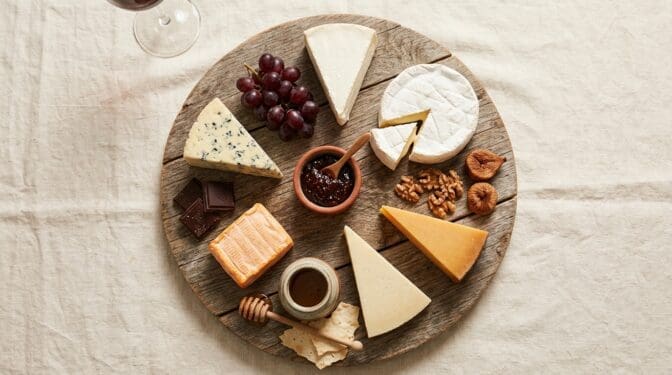
Use a wooden board, not a plate. The wood breathes; the plate sweats. A 30cm round or 40cm rectangular board fits six cheeses comfortably for four to six guests. Lay the cheeses in order from lightest to heaviest, going clockwise around the board so guests can move through them without backtracking. Put each cheese on its own small spot, with at least 4cm of space between them. The space is where the accompaniments go.
Accompaniments are the often-forgotten quarter of the board. A small bunch of grapes (red and green), a handful of dried figs or apricots, a small jar of fig jam or quince paste (Maggie Beer’s is the household standard), a few dark chocolate squares (any 70% dark, Lindt or Loving Earth), and a scatter of walnuts and almonds. A few crackers and a sliced baguette. Honey if you have it, particularly with the blue. The accompaniments are what your guests will reach for between cheeses to refresh the palate.
Knife discipline matters. One knife per cheese, minimum. The blue knife should never touch any other cheese, or every cheese will taste of blue. The hard cheese knife is a different shape (heavier, often with a forked tip) than the soft cheese knife (long, thin, sharp). If you only have one knife of each type, that is fine; just wipe between cheeses. Do not share a knife between blue and anything else. Blue is intense enough that even a microscopic transfer ruins the next cheese.
The cheeses, side by side

Bottle
For Aged Cheddar
Pair with: Pyengana Cheddar (Tasmania) or Section 28 Mountain Man (Adelaide Hills).

Bottle
For Camembert or Brie
Pair with: Section 28 Monforte (Adelaide Hills) or Tarago River Shadows of Blue (Gippsland).

Bottle
For Blue
Pair with: Berry’s Creek Riverine Blue (Gippsland) or Roaring Forties Blue (King Island).


Frequently asked questions
How much cheese do I need per person for a cheese board?
Plan 80 to 100 grams of cheese per person if it is the appetiser portion of a meal, 150 to 200 grams per person if the cheese board is the meal. Six cheeses for four guests means about 600 to 800 grams of cheese total in the appetiser case. Buy slightly more than you need; leftover cheese keeps for a week.
What order should I eat cheeses in?
Lightest to heaviest. Start with fresh goat’s cheese, then bloomy soft cheeses (camembert, brie), then hard aged (cheddar, comté, pecorino), then washed-rind, then blue last. The blue is the most assertive flavour on a normal board and will dominate your palate for the next ten minutes if eaten earlier.
What wines go with a cheese board?
Two or three wines spanning the board: a crisp white (sauvignon blanc, riesling, or chardonnay) for the soft cheeses, a medium-bodied red (shiraz, cabernet, sangiovese) for the hard aged cheeses, and a sweet wine (Sauternes, tawny port, sticky riesling) for the blue. Beer also pairs beautifully with washed-rind cheese (Belgian Trappist, Australian craft amber ale).
Should cheese be served at room temperature?
Yes. Take cheese out of the fridge 45 minutes before serving and unwrap it. Cold cheese tastes about 30% flatter than room-temperature cheese; the aromatic compounds are dampened by cold. Room temperature also softens the texture, making soft cheeses spreadable and hard cheeses easier to slice.
What accompaniments should I include?
Crackers and a sliced baguette. Grapes (red and green). Dried figs or apricots. A small jar of fig jam or quince paste (Maggie Beer’s is reliable). Walnuts and almonds. A few squares of dark chocolate. A small bowl of honey, particularly for the blue. Avoid anything overly sweet or salty as a default; the cheeses already deliver both.
How long can I leave cheese out at room temperature?
Two to four hours is safe in a normal Australian winter (under 22°C ambient). Hard cheeses last longer than soft cheeses; bloomy cheeses (camembert, brie) start to weep after about 90 minutes and should be returned to the fridge if not finished. Always rewrap with fresh paper before refrigerating leftovers.