
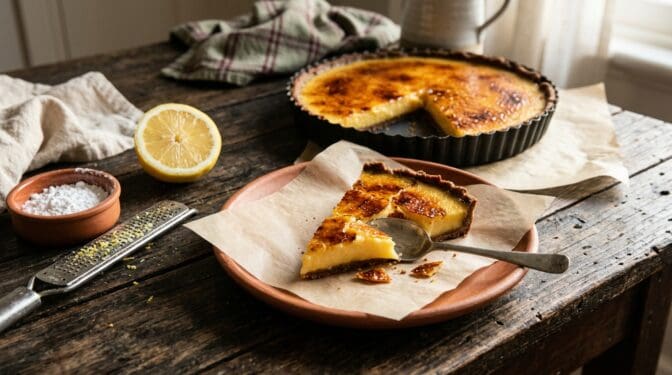
Shortcrust, lemon curd that hits sharp and lands soft, a glassy brûlée top you crack with a spoon. The August dessert when the lemons finally taste like lemons.
Why you should bake this
The first time I made a lemon tart properly I was twenty-six, hosting a dinner party I had volunteered for in the kind of optimistic mood you get on a Tuesday when the rent is paid and the fridge is empty. I had read a Stephanie Alexander recipe at lunch, bought a kilo of lemons at the Marrickville fruit shop on the way home, and decided I could blind-bake a shortcrust between the entrée and the main without anyone noticing.* The pastry shrank like a wool jumper in a hot wash. The curd over-cooked because I was simultaneously plating the lamb. The brûlée top was achieved with a kitchen torch I had bought four hours earlier from the Newtown Asian grocer and operated, briefly, like a man defusing a bomb.
(*“Just a quick lemon tart between courses” is the dinner-party equivalent of “I’ll be there in five minutes.” It is never a quick lemon tart. Plan for the lemon tart. Make the curd in the morning. Bake the shell when you wake up. Brûlée the top while the kettle boils for the coffee.)
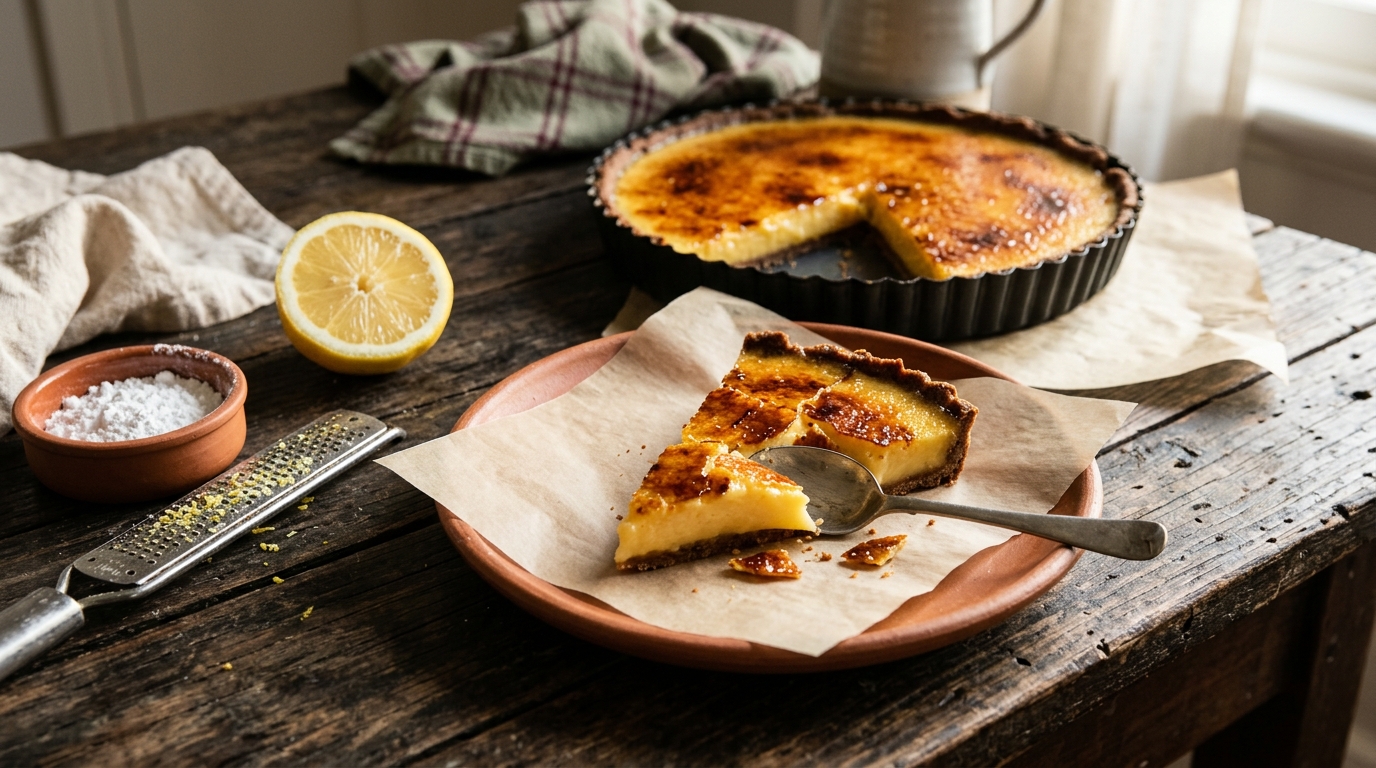
That is the dish, only with the timing fixed. A buttery shortcrust, blind-baked properly with weight in the bottom and an egg-wash seal so the curd doesn’t leak through. A lemon curd made on the stove with whole eggs, sugar, butter, the zest and juice of three Eureka or Lisbon lemons. Poured warm into the cooled shell, set in the fridge for two hours minimum. A thin even sprinkle of caster sugar over the top, brûléed with a butane torch (a Bunnings creme brûlée torch is $32 and lasts a decade) until the sugar is glassy amber. Slice with a hot knife. Serve cold. Watch the room go quiet.
Use Australian Eureka or Lisbon lemons, in season from May through to October. The Meyer lemon at the supermarket is sweeter and lower-acid; it will make a softer, less-bracing tart that nonna will tell you is “nice” in the polite voice she reserves for things that disappointed her. Pick a lemon that feels heavy for its size, with a thin glossy skin. The Marrickville Metro Coles has a passable bag, the local IGA has the better single fruit, and a Saturday Carriageworks farmer’s market lemon will outperform both for around $2 each.
What to drink with it
A late-harvest Riesling or a Coonawarra Riesling Trockenbeerenauslese-style sticky if you want to lean dessert-wine. The classical pour. Pewsey Vale Eden Valley Riesling at $25 from Dan Murphy’s works as a bracing dry-acid contrast; the De Bortoli Noble One ($30 a half-bottle) is the upgrade if you have the budget and the company to justify a sticky. A glass of cold Tasmanian sparkling (Jansz NV at $30) also works: the bubbles cut the sugar, the lemon and the wine echo each other in a polite back-and-forth that does no real damage to either.
Recipe · Dessert
Burnt Basque Cheesecake
The Basque burnt cheesecake is the laziest dessert that looks the most impressive. Why you are cooking this tonight The Basque burnt cheesecake is the laziest dessert that…
Read the recipe →
Recipe · Dessert
Dark Chocolate Mousse
The chocolate mousse is the dinner party dessert that makes people think you went to a cooking school in Paris. Why you are cooking this tonight The chocolate…
Read the recipe →
Notes from the kitchen
Blind-bake the shell for real. Roll the pastry to 3mm, line a 24cm fluted tin, prick the base lightly, line with baking paper and fill to the brim with rice or dried beans (or proper ceramic baking weights, which you will use twice a year for the rest of your life). Bake at 180°C fan-forced for 18 minutes. Lift the paper and weights out, brush the base and sides with a beaten egg yolk to seal, return to the oven for 8 more minutes until the pastry is pale gold. Cool fully before adding the curd. A warm shell will go soggy on you and there is no recovery from soggy.
Cook the curd low and slow over a double boiler, never directly on the heat. Whole eggs, caster sugar, lemon zest and juice, cubed butter added at the end. Whisk constantly. The curd is done when it coats the back of a wooden spoon and a finger drawn across leaves a clean line. Strain through a fine sieve to catch the zest and any over-cooked egg. Pour warm into the cooled shell, smooth with the back of a spoon, refrigerate for at least two hours. Overnight is better. The curd firms into a sliceable set.
Brûlée just before serving. Sprinkle a thin even layer of caster sugar across the top of the chilled tart (a teaspoon per slice is the right ratio; too much and the sugar burns into bitterness, too little and you get no glass). Hold the torch 10cm above the surface and move steadily across, watching the sugar melt and bubble and turn deep amber. Stop just before the colour hits dark mahogany; the residual heat carries it the last shade. Let it cool for 90 seconds so the sugar sets into the brittle shatter that is the whole point. Cut with a sharp knife dipped in hot water and wiped between cuts.
Two things that go wrong
Pastry has shrunk down the sides of the tin and the curd has over-spilled
You skipped the second blind-bake or you under-rested the dough. Rest the dough in the fridge for an hour after rolling, then again for 20 minutes after lining the tin (chill it before it goes into the oven). The shrink happens when the gluten contracts in the heat without being relaxed first. There is no save for an already-shrunk shell; pour any escaped curd into ramekins, brûlée separately, call it a kitchen accident special.
Brûlée top is patchy and pale instead of an even glassy amber
Sugar layer was uneven, or torch was too close, or both. Hold the torch 10cm away and move it constantly in small circles. If the top has ended up patchy, sprinkle another half-teaspoon over the pale spots and torch again. The repair is invisible once cool. The tart does not know the second brûlée was a recovery operation.
Variations worth knowing
Blood orange tart (the August twin)
Replace the lemon zest and juice with blood orange (about 250ml of strained juice from 4 to 5 oranges). Keep the lemon juice down to a single tablespoon for acid balance. The curd turns a soft pink-amber and tastes like a slightly grown-up lolly. Brûlée the same way. Australian blood oranges are at peak in August (Mildura growers, Harris Farm).
Lemon tart with thyme (the herbal one)
Steep a tablespoon of fresh thyme leaves in the warm cream as the curd cools, strain before pouring. The thyme adds a savoury back-note that makes the tart taste like a proper Provencal dessert. Skip the brûlée on this version; serve dusted with icing sugar instead. The thyme deserves to be tasted, not buried in caramel.
No-bake lemon tart (the cheat)
Skip the shortcrust. Press 250g of crushed gingernut biscuits and 100g of melted butter into the tin, refrigerate 30 minutes, pour the curd in cold, refrigerate 4 hours. Brûlée the top as usual. Twenty minutes of work for a near-identical result. The dinner party shortcut nobody will object to.
Leftovers and make ahead
The tart keeps in the fridge for three days, covered loosely with foil (cling film against the brûlée turns the surface tacky). The brûlée softens overnight; if you want the glass back, sprinkle a fresh half-teaspoon of sugar across the slice just before serving and torch again. Or eat it soft. Day-two lemon tart with a softened crust is its own quiet pleasure, eaten standing at the kitchen counter with a coffee on a Sunday morning while you decide whether to start the day or not.
Day-three curd, scraped out of the shell, becomes a sandwich filling between two layers of cold pavlova or a topping on a yoghurt bowl. It also folds into softly whipped cream as a quick lemon mousse. The shortcrust scraps, broken up and toasted in a low oven for ten minutes, become the world’s most respectable cheesecake base. Nothing here is wasted. The lemon paid for itself.
The recipe
[fd-wprm-placeholder]
Ingredients
Method
- Pulse the flour, butter and icing sugar in a food processor until the mixture resembles coarse breadcrumbs. Add the yolk and water, pulse just until it forms a ball. Wrap in cling film and refrigerate 1 hour.
- Roll the pastry to 3mm thick on a lightly floured bench. Line a 24cm fluted tart tin, trim the edges. Prick the base lightly. Refrigerate 20 minutes.
- Preheat oven to 180°C fan-forced. Line the pastry with baking paper and fill to the brim with rice, dried beans or ceramic baking weights. Bake 18 minutes.
- Lift out the paper and weights. Brush the base and sides with the beaten egg yolk. Return to the oven for 8 minutes until pale gold. Cool completely on a rack.
- Combine the lemon zest, juice, sugar, eggs and extra yolk in a heatproof bowl set over a saucepan of simmering water (the bowl shouldn’t touch the water).
- Whisk constantly for 8 to 10 minutes until the curd thickens and coats the back of a spoon. Remove from the heat.
- Whisk in the cold butter cubes one at a time until smooth and glossy. Strain through a fine sieve into a clean bowl.
- Pour the warm curd into the cooled tart shell. Smooth the top with the back of a spoon. Refrigerate at least 2 hours, ideally overnight.
- Just before serving, sprinkle the caster sugar in a thin even layer across the surface of the chilled tart.
- Hold a butane torch 10cm above the surface. Move steadily across the tart until the sugar melts, bubbles and turns deep amber. Stop just before mahogany.
- Let the sugar cool for 90 seconds until brittle. Slice with a hot knife wiped between cuts. Serve immediately.