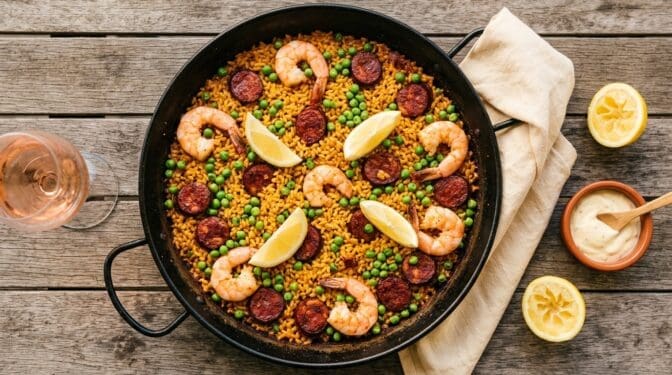
Bomba rice, saffron, prawns, chorizo, peas in a wide pan in 30 minutes flat. Not the four-hour Valencian project; the Sunday-afternoon home version that actually gets cooked.
Why you should cook this
The proper paella, as cooked in Valencia by people who take the dish very seriously and will gently correct you if you call something a paella that is not made with rabbit and snails over an open wood fire, is a four-hour project that requires equipment you do not own and ingredients you cannot find. The 30-minute paella is not that paella. The 30-minute paella is the dish that lets you put a wide shallow pan on a Sunday-afternoon stove and cook a saffron-stained rice with prawns and chorizo and peas, and have nine people eat it standing in the kitchen with a glass of cold rose, and call it a Saturday. It is a different dish. It is also one of the great weekend hosting moves and the Valencians do not need to know.
The technique that makes a 30-minute paella work is the wide shallow pan. The traditional paella pan is 38cm to 50cm across, made of carbon steel, with a thin base. The width matters because paella rice is supposed to cook in a shallow even layer (no more than 2cm deep), where the bottom develops a caramelised crust (the socarrat) and the top steams to tenderness. A deep pot will give you risotto. A wide pan will give you paella. A 38cm carbon-steel pan from any good cookware shop costs $50 and lasts a lifetime; the IKEA stainless option at $25 also works. A wide cast-iron pan (Lodge 12-inch) is the everyday alternative if you don’t want to buy a dedicated pan.
The rice has to be the right rice. Bomba is the standard; it is a short-grained Spanish rice that absorbs three times its weight in liquid without breaking down. Calasparra is the classical equivalent. Both are available at quality delis (Vic’s in Surry Hills, the Spanish deli at Marrickville Metro, Yum Cha grocery in Carlton) for around $12 a 500g bag. The Coles short-grain rice is fine as a substitute but breaks down faster; the Carnaroli that you used for risotto last week is a closer substitute. Avoid jasmine, basmati, and any long-grain rice; the texture is wrong for paella.
The chorizo is the second flavour layer. Use a Spanish cooking chorizo (firm, not the cured slicing chorizo), available from the deli aisle of any decent Spanish or Italian shop. Iberico chorizo is the upgrade ($35/kg from Vic’s); the supermarket Spanish-style chorizo at Coles ($14/kg) is the everyday alternative. The chorizo renders its paprika-stained orange oil into the rice; without it the paella is pale and one-note.
What to drink with it
A cold dry rose. Provence rose, or an Australian rose from a producer who takes it seriously (Charles Melton Rose of Virginia at $25 from Dan Murphy’s, Ravensworth Sangiovese Rose at $30, La Vieille Ferme Provence Rose at $22). The rose’s acidity cuts the chorizo’s fat and the paella’s richness; the colour matches the saffron in the pan. A crisp Albariño (Spanish white from the Rias Baixas; Burgans Albariño at $30) is the regional pair. Avoid heavy red; the Shiraz will smother the seafood.
Recipe · Dinner
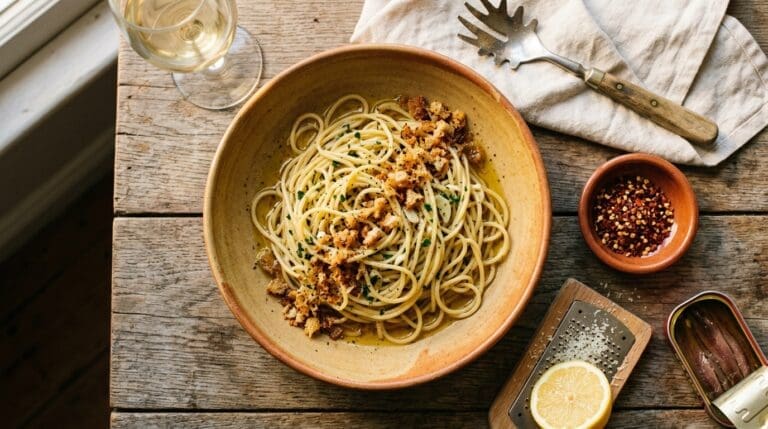
Spaghetti with Anchovy and Garlic
Spaghetti aglio e olio with anchovies dissolved into the oil. Five ingredients. Twelve minutes. The Italian-pantry classic that explains why the Italians win at dinner. Why you should…
Read the recipe →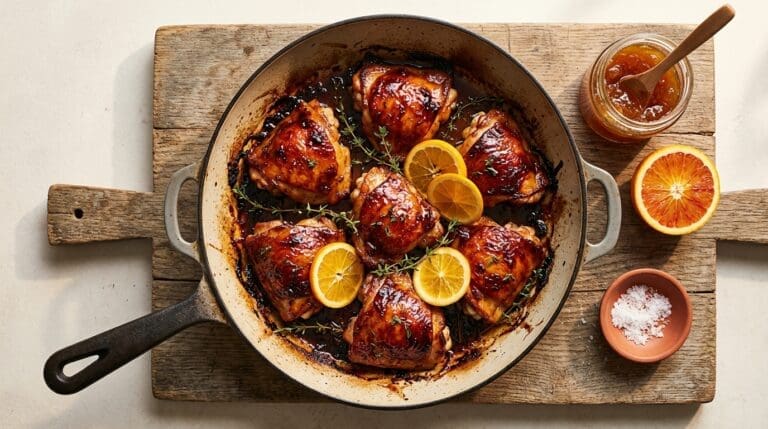
Recipe · Dinner
Marmalade-Glazed Chicken Thighs
Bone-in thighs, bitter Seville marmalade, soy, mustard, garlic. Sticky, sweet, savoury, the kind of one-tray Sunday roast that solves dinner and lunch. Why you should cook this Bitter…
Read the recipe →
Notes from the kitchen
Build the sofrito first. The sofrito is the flavour base: olive oil, finely diced onion, finely diced red capsicum, garlic, smoked paprika, a tin of chopped tomatoes reduced down hard. Cook the sofrito in the wide pan over medium heat for 8 to 10 minutes until the tomatoes have lost most of their water and the mixture is a deep brick-red. The sofrito is the foundation; rushing it will give you a paella that tastes underdeveloped.
Add the chorizo in chunky rounds, brown for two minutes. Add the bomba rice; toast in the oil and the chorizo fat for two minutes, stirring constantly, until the grains are coated and the rice has turned slightly translucent at the edges. Pour over hot stock (chicken or seafood; about 750ml for 250g of rice, which is the standard 3:1 liquid-to-rice ratio for bomba). Add a generous pinch of saffron threads (genuine Spanish saffron; the cheap supermarket saffron is usually safflower, which is a different plant and does nothing for the dish). Stir once. Do not stir again.
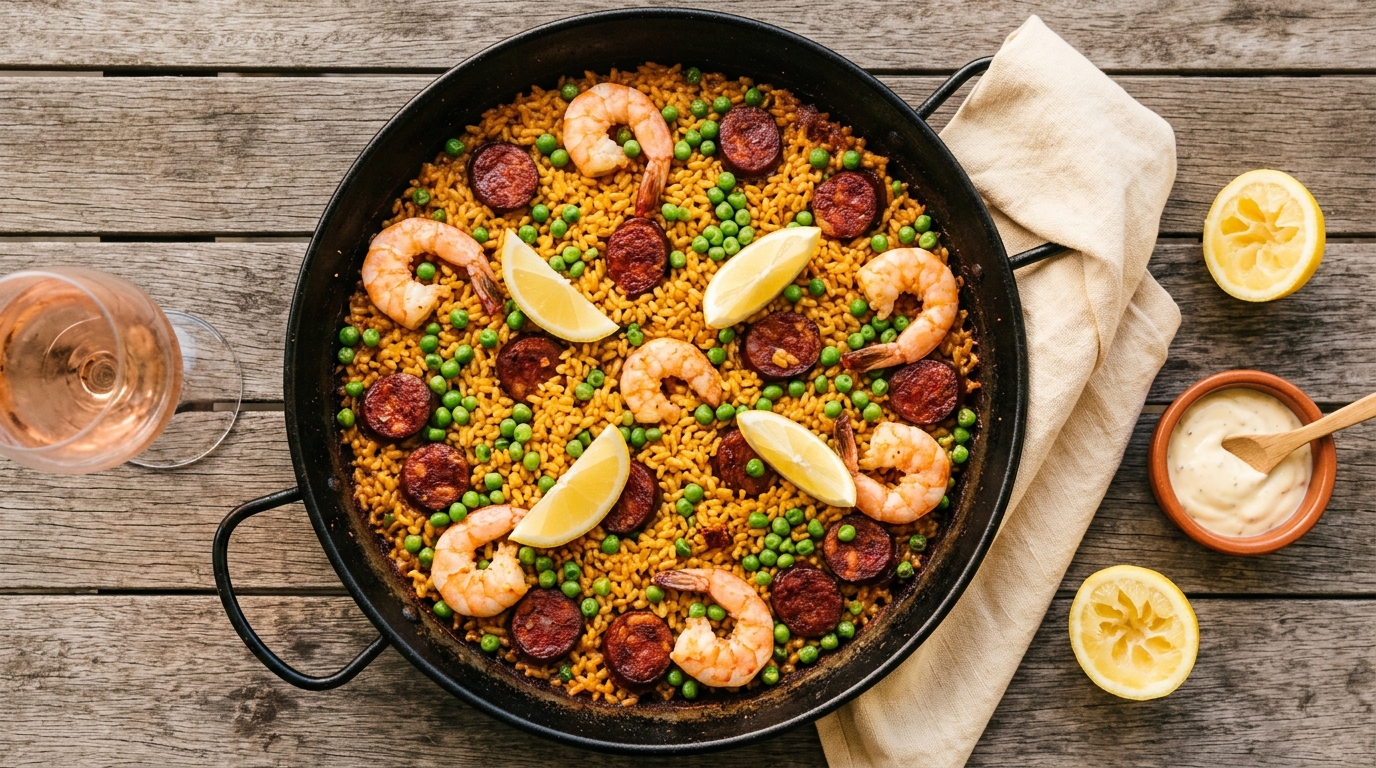
Simmer uncovered over medium heat for 15 minutes. The rice absorbs the liquid; the surface goes from glossy to dry. Arrange the prawns and the peas across the surface in the last 5 minutes. Push the heat to high for the final 90 seconds to develop the socarrat (the caramelised crust on the bottom; you should hear the rice start to crackle). Take the pan off the heat. Cover with a clean tea towel for 5 minutes to rest. Serve in the pan, with lemon wedges around the edge.
Two things that go wrong
Rice is undercooked and crunchy in the middle of the pan
You did not use enough liquid, or your heat was too low. Bomba rice needs the full 3:1 liquid ratio; if your rice is still crunchy at the 15-minute mark, add another 100ml of hot stock around the edges of the pan, push the heat to medium-high for 5 more minutes. Do not stir; the rice cooks from the bottom up.
No socarrat crust on the bottom
Your final-90-seconds heat push was not aggressive enough. The socarrat develops only at high heat; push the gas to maximum for the last 60 to 90 seconds, listen for the rice to crackle. If you are not hearing the crackle, push another minute. Lift a spoonful from the bottom; the crust should be a deep amber-brown, not pale gold.
Variations worth knowing
Seafood paella (the showy one)
Skip the chorizo. Add 200g of mussels and 200g of clams in the last 10 minutes (cover with foil for the first 5 to steam them open). Add 6 prawns, head-on, across the surface. Garnish with chopped parsley and lemon. The version for the long Saturday lunch with seven people.
Chicken and chorizo paella
Skip the seafood. Use 6 bone-in chicken thighs cut in half, browned hard at the start before the sofrito. The Valencian-leaning version, deeper and more rustic. Pair with a Tempranillo instead of a rose.
Vegetarian paella
Skip the chorizo and prawns. Use 200g of artichoke hearts (frozen or jarred), a tin of butter beans, 200g of green beans cut into 4cm lengths. Add a generous pinch of smoked paprika to the sofrito to compensate for the missing chorizo smoke. Surprisingly satisfying.
Leftovers and make ahead
Day-two paella is, controversially, the best paella. The flavours deepen overnight; the rice continues to absorb the residual liquid; the socarrat crust softens but the flavour intensifies. Reheat gently in a low oven (160°C for 15 minutes, covered with foil) or in a wide pan over low heat with a splash of stock. Avoid the microwave; the rice goes from al dente to mush in 90 seconds.
Cold leftover paella becomes an instant fritter mix. Beat two eggs into a cup of cold paella, form into patties, fry in olive oil for 3 minutes per side until amber-brown. Top with a squeeze of lemon and a dollop of aioli. Lunch sorted. The Spanish call this arroz frito; it is the kind of food that invented the concept of leftovers being better than the original.
The recipe
[fd-wprm-placeholder]
Ingredients
Method
- Heat the olive oil in a wide shallow paella pan or 30cm cast-iron pan over medium heat. Add the onion and capsicum, cook 5 minutes until softened.
- Add the garlic and smoked paprika, cook 1 minute. Add the chopped tomatoes, cook 6 to 8 minutes until reduced to a thick brick-red sofrito.
- Add the chorizo rounds, brown 2 minutes.
- Add the rice, stir to coat in the chorizo oil for 2 minutes until the grains turn slightly translucent at the edges.
- Pour over the hot stock. Crumble the saffron between your fingers as you add it. Season with salt and pepper. Stir once. Do not stir again.
- Simmer uncovered over medium heat for 15 minutes, until the surface goes from glossy to dry.
- Arrange the prawns across the surface, push them slightly into the rice. Scatter the peas. Cook another 5 minutes.
- Push the heat to high for the final 60 to 90 seconds. Listen for the rice to crackle (this is the socarrat developing).
- Take the pan off the heat. Cover with a clean tea towel. Rest 5 minutes.
- Scatter with chopped parsley. Arrange lemon wedges around the edge. Serve in the pan, at the table.