
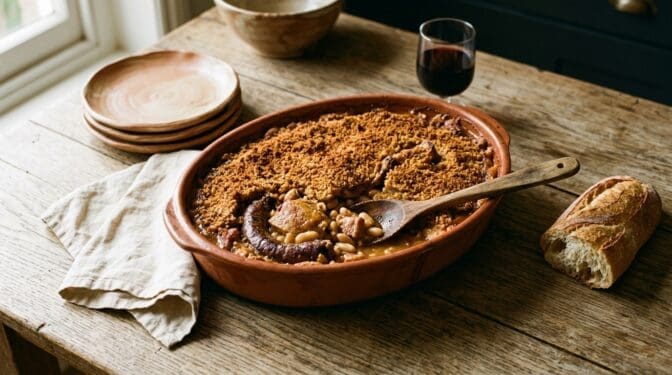
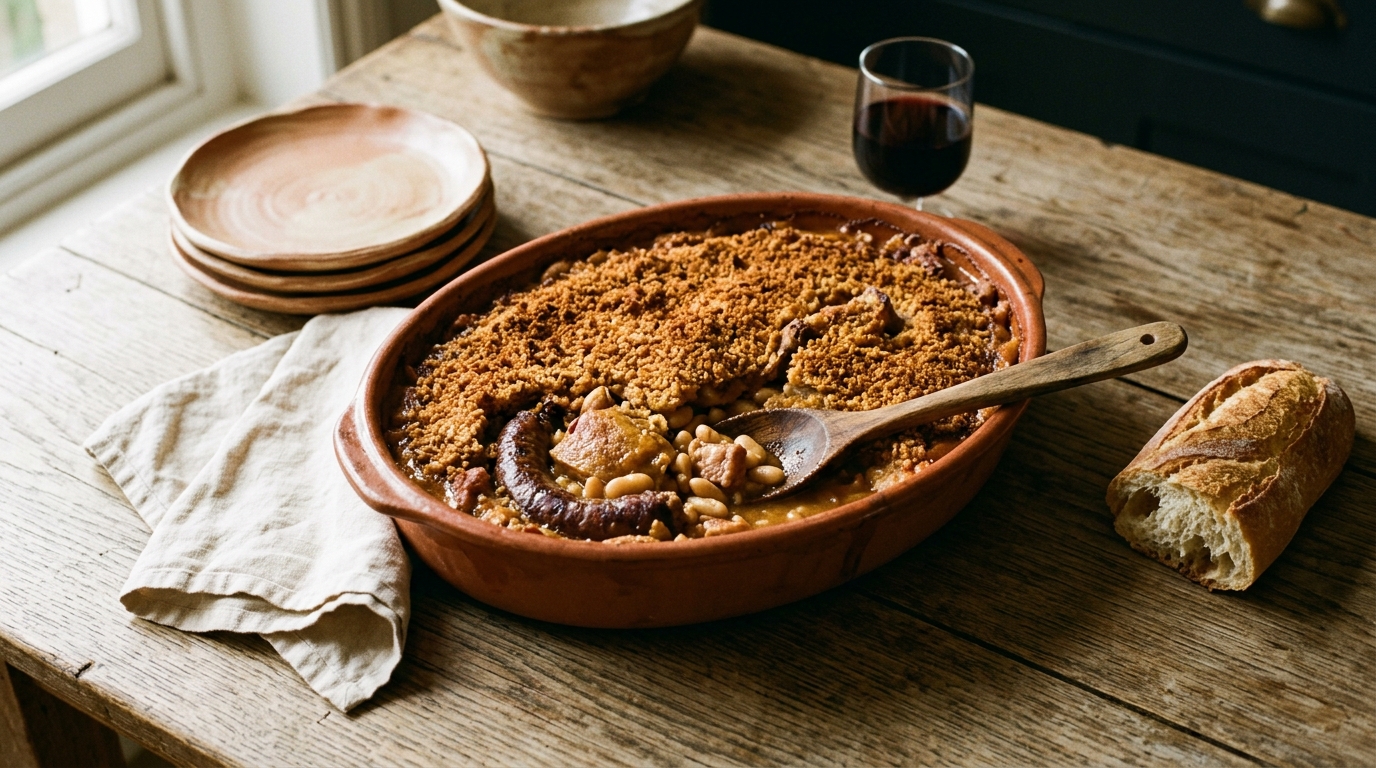
Duck confit, Toulouse sausage, white beans, three layers of breadcrumb crust broken back into the pot. The Sunday project that becomes Monday lunch and Tuesday dinner.
Why you should cook this
The first time I attempted cassoulet I read a Paula Wolfert article on a Saturday morning, drove to four different shops looking for duck confit and Tarbais beans, found neither, substituted store-bought duck legs and dried haricot beans from the Marrickville IGA, and proceeded to spend the next nine hours in a state of low-level anxiety about the breadcrumb crust. The crust must be broken back into the dish three times during cooking. This is how it gets its texture. The texture is the whole point. By the third break I was telling my wife about a thing called the “cassoulet bargain” that I had invented twenty minutes earlier in an attempt to justify the time investment to myself. The bargain held. The cassoulet was extraordinary.
That is the dish. White beans cooked slowly in a stock made from the bones of every animal involved, layered with duck confit and Toulouse sausage and (in some traditions) pork shoulder, topped with garlicky breadcrumbs, baked in a wide terracotta dish until the top is amber and the inside is the kind of creamy bean that has surrendered entirely.* The break-the-crust three times trick is non-negotiable. Each break reveals a fresh layer of beans which forms a new crust on top. By the end you have three crusts stacked into the dish and the texture is bean cream below, crisp shatter above, with two soft amber bands in between.
(*Cassoulet is named after the dish it is cooked in, the cassole, a wide shallow terracotta vessel that is wider than it is deep. The shape matters. A deep narrow pot will not give you enough surface area for the crust. If you do not own a cassole, use a wide oval Le Creuset or a 30cm cast-iron pan. A casserole dish in any other shape is a stew. We are not making a stew.)
The duck confit is the heart of the dish and the bit that scares people. You can make it yourself (legs salted overnight, slow-cooked in their own fat for four hours), or you can buy it pre-confitted from any decent French-style butcher (Vic’s Premium Quality Meat in Surry Hills, Hudson Meats in any of their Sydney shops, or the duck legs in tins from Vinotopia for around $25 a leg). The supermarket version is not a substitute. There are some hills the voice will die on.
What to drink with it
The classical pair is a Languedoc red, a Faugères or Minervois, but the Australian translation is a Mourvèdre-led GSM. Yangarra GSM at $30 from Dan Murphy’s is the everyday bottle; Hentley Farm The Beauty at $45 is the upgrade. If you want to sidestep into a single varietal, a Heathcote shiraz with some pepper and structure (Tellurian at $35) does the same job. Whatever you pour, open the bottle ninety minutes before the cassoulet comes out of the oven; this is not the wine for room-temperature tannins.
Recipe · Dinner
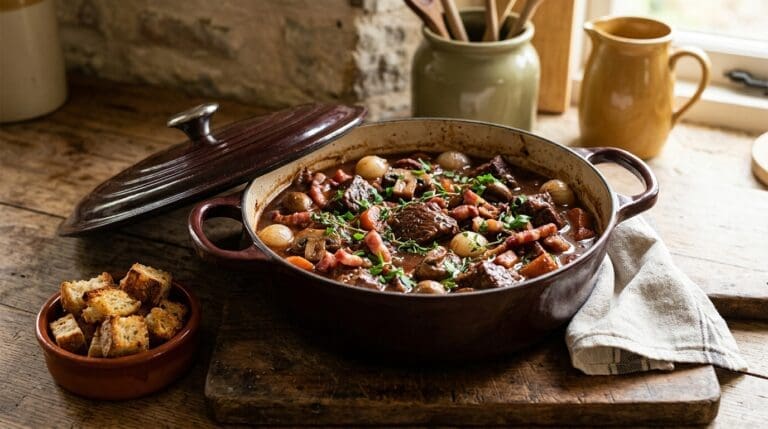
Boeuf Bourguignon
Beef chuck, half a bottle of red, three hours of nothing to do but check on it twice. The dish that justifies winter. Why you should cook this…
Read the recipe →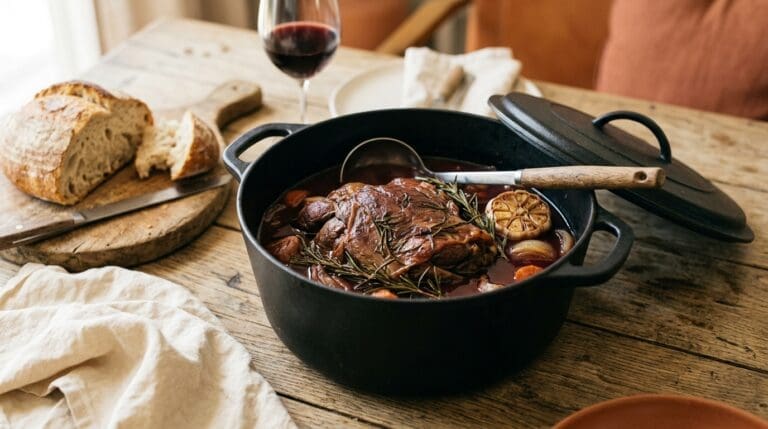
Recipe · Dinner
Slow-braised lamb shoulder with red wine and rosemary
There is a category of dinner where you accept that you are going to lose six hours of your Saturday and gain a house that smells like the…
Read the recipe →
Notes from the kitchen
Soak the beans overnight. Tarbais beans if you can find them (they hold their shape and have a buttery interior), great northerns or cannellini if you cannot. Twelve hours in cold water is the minimum; eighteen is better. Drain, then cook in fresh stock with onion, carrot, garlic, a bouquet garni and a pork rind or two for body. The beans are done when they are tender but still hold their shape, about 90 minutes at a low simmer. Salt the beans only at the end; salt early and the skins toughen.
Brown the sausage and the duck legs separately, hard, in a wide pan. Layer everything in the cassole: half the beans on the bottom, all the meat on top, the rest of the beans over, enough cooking liquid to come three-quarters up the surface. Cover the top with breadcrumbs (panko mixed with chopped parsley, garlic and a glug of olive oil). Bake at 160°C fan-forced. After 45 minutes, when the crust is amber, push it back into the beans with the back of a wooden spoon. Bake another 30 minutes. Push again. Bake another 30. Push again. By the third break you should have a thick layered cap. Add stock if it dries out at any point.
Two things that go wrong
Cassoulet is dry and the beans are bullet-hard
You did not soak long enough or you cooked too hot. The beans need slow heat in stock to soften properly. Add another 200ml of hot stock, cover with foil, return to a 150°C oven for 45 minutes. The beans will continue to soften. Salt at the end if needed.
Crust is pale and soft instead of crisp
Your oven is not hot enough or you broke the crust too soon. The first crust forms over 45 minutes at 160°C; if it is still soft at that point, push the temperature to 180°C for the next 20 minutes, do not break it until it is amber. Be patient. The crust takes time.
Variations worth knowing
Toulouse-style (the classic)
Tarbais beans, duck confit, Toulouse pork sausages, pork shoulder cubed and browned. The fullest version. Three meats, three days of work, the dish that justifies an entire weekend.
Quick weekday cassoulet
Tinned cannellini beans, store-bought duck confit, decent pork sausages from the butcher. Skip the bean-cooking step; layer everything straight into the cassole with stock and breadcrumbs. 90 minutes total. Not the real thing, but a respectable Tuesday version.
Vegetarian cassoulet (the heretical one)
Skip the meat. Use a kilo of mixed mushrooms (chestnut, oyster, field) browned hard in olive oil, plus a tin of butter beans and a tin of cannellini for body. Smoked paprika in the breadcrumbs gives the meaty depth. The French would object. Cook it anyway.
Leftovers and make ahead
Cassoulet is the rare dish that gets better for the next three days. The bean cream deepens, the meat melts further into the beans, the crust softens slightly but stays meaningfully crisp at the edges. Reheat in the oven at 160°C for 25 minutes with foil on; remove the foil for the last 10 minutes to crisp the crust. Add a splash of stock if it has dried out.
Day-three cassoulet is also extraordinary spread thick on toasted sourdough as a brunch dish, with a fried egg on top. The dish has stopped being cassoulet and is now a beans-on-toast that has read too many cookbooks. Eat it standing at the counter, alone, while the kettle boils.
The recipe
[fd-wprm-placeholder]
Ingredients
Method
- Drain the soaked beans. Place in a large pot with the stock, halved onion and carrot, the 4 whole garlic cloves, bouquet garni and pork rind. Bring to a simmer; cook gently for 90 minutes until the beans are tender but hold shape. Salt to taste at the end. Discard the onion, carrot and bouquet garni.
- Preheat oven to 160°C fan-forced.
- Heat duck fat in a wide pan over medium-high. Brown the sausages for 3 minutes per side. Set aside. Brown the pork shoulder cubes (if using) hard, 4 minutes per side. Brown the duck confit legs skin-side down for 4 minutes until the skin crisps. Set everything aside.
- Mix the breadcrumbs, parsley, crushed garlic and olive oil in a bowl until well coated.
- Layer in a wide cassole or oval baking dish: half the beans, all the meat (sausages cut in half, pork cubes, duck legs), then the rest of the beans. Add enough bean cooking liquid to come three-quarters up the surface.
- Sprinkle the breadcrumb mixture evenly over the top. Bake 45 minutes until the crust is amber.
- Push the crust back into the beans with the back of a wooden spoon. Bake another 30 minutes. Push again. Bake another 30 minutes. The final crust should be thick, layered and crisp on top.
- Rest 15 minutes before serving. Spoon onto warm plates with crusty bread on the side.