A pairing guide for the dishes you actually cook in winter. Mac and cheese, shepherd’s pie, fish and chips, lasagne, roast chicken, steak and mash. Wine, cocktail and a brief explanation of why each pairing works, written by people who have spent more time eating these dishes than is medically advisable.
- The principle of pairing comfort food
- The six dishes (with wine + cocktail pairings)
- The bottles to keep on hand
- Frequently asked questions
The principle of pairing comfort food
Comfort food has a particular set of pairing demands. It is rich. It is fatty. It is usually slow-cooked or oven-baked. It tastes like a hug your nonna gave you in 1994. None of those qualities are a problem for the right wine; all of them are a problem for the wrong one. The wrong wine is too tannic (the tannin clings to the fat and amplifies the heaviness) or too sweet (the sweetness pushes the dish into cloying) or too acidic (the acid strips the comfort). The right wine is medium-bodied, has integrated tannin, has matching acidity, and shares at least one flavour register with the dish.
The cocktail pairing is a different conversation. With comfort food, the cocktail is usually the bookend rather than the accompaniment: an aperitif before the meal, a digestif after. The drink during the meal is almost always wine or beer. The cocktail before should stimulate appetite (something bitter or citrus-led, low on sugar); the cocktail after should aid digestion (something with herbal bitterness, served in small sips). Avoid sweet cocktails with rich food; the contrast goes ugly fast.
The third register is the regional pair: cook a French dish, drink a French wine; cook an Italian dish, drink an Italian wine. This is sometimes called the “what grew there, drinks there” principle and it is correct more often than it is wrong. It is also the easiest pairing principle to remember: when in doubt, match country to country. The Australian translation works too: a McLaren Vale GSM is the Australian Cotes du Rhone; a Yarra Valley pinot is the Australian Burgundy; a Hunter Valley semillon is the Australian Loire white.
The six dishes
Mac and Cheese
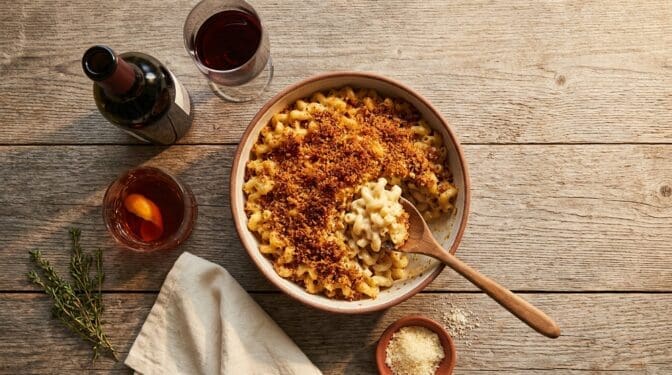
The pasta-and-cheese-bake that became Australia’s honorary national dish during lockdown. Cheddar, gruyere, occasionally truffle.
Wine: Yarra Valley Chardonnay (Yabby Lake at $48) or a Tasmanian Pinot Noir (Tolpuddle at $70). The chardonnay matches the cream and oak in the cheese; the pinot has the acidity to cut the fat.
Cocktail: A Smoked Old Fashioned (rye, demerara, applewood smoke). The smoke amplifies the toasted breadcrumb top.
Shepherd’s Pie
Lamb mince braised in stock with carrots and peas, topped with mashed potato, baked until amber. The British pub classic.
Wine: A Barossa Shiraz (Hentley Farm The Beauty at $45) or a Margaret River Cabernet Merlot (Cape Mentelle at $30). Both have the structure to stand up to lamb.
Cocktail: A Hot Toddy (Scotch, hot water, honey, lemon, clove). The honey echoes the caramelised mash; the lemon cuts the gravy.
Fish and Chips
Beer-battered flathead, hand-cut chips, malt vinegar, lemon. The Australian beach classic that works equally well as a Friday-night winter dinner.
Wine: A crisp Hunter Valley Semillon (Tyrrell’s Vat 1 at $50) or a dry Riesling (Pewsey Vale Eden Valley at $25). Both have the acidity to cut through the batter.
Cocktail: An Aperol Spritz or a Gin and Tonic. The bitterness and the bubbles match the salty, vinegar-coded fish.
Lasagne
Slow-cooked beef ragu, layered between fresh pasta sheets, bechamel and parmesan, baked until amber. The Italian Sunday classic that became a Tuesday weeknight standard.
Wine: A Sangiovese (Banfi Centine at $20) or a Chianti Classico (Castello di Ama at $45). Both have the acidity to lift the rich tomato; the Chianti adds dried-cherry notes that play with the beef.
Cocktail: A Negroni or a Vieux Carre. The bitter aperitif softens the richness without smothering the dish.
Roast Chicken
A whole bird, brined overnight, butter under the skin, lemon and thyme inside, roasted at 220°C until the skin is amber and the juices run clear.
Wine: A medium-bodied Yarra Valley Pinot Noir (Giant Steps at $42) or a lightly oaked Chardonnay (Mac Forbes RS3 at $30). The pinot is the conventional pair; the chardonnay is the upgrade.
Cocktail: A White Negroni (gin, Lillet Blanc, Suze) or a French 75. Both have the herbal lift to match the lemon and thyme.
Steak and Mash
A 250g sirloin or eye fillet, seared hard in butter, served on creamy potato mash with a red wine pan-jus. The Friday-night reward.
Wine: A McLaren Vale Shiraz (Yangarra at $25) or a Coonawarra Cabernet (Wynns Black Label at $55). The shiraz has the fruit; the cabernet has the structure.
Cocktail: A Manhattan (rye or bourbon, sweet vermouth, Angostura). The drink has the same weight as the steak.
The bottles to keep on hand
If you cook these six dishes regularly, the seven bottles below cover every wine pairing in this guide. Buy a single bottle of each, store horizontally, and you have a working comfort-food cellar for under $200.


Frequently asked questions
What wine goes best with mac and cheese?
A Yarra Valley Chardonnay with some oak (Yabby Lake Single Vineyard at $48 is the upgrade pour; Mac Forbes RS3 at $30 is the everyday option). The chardonnay matches the cream and oak in the cheese; the acidity refreshes the palate between bites. A Tasmanian Pinot Noir also works as a contrast pairing; the pinot’s acidity cuts the fat. Avoid heavy reds; they will smother the dish.
Can I drink red wine with fish and chips?
Generally no. Fish and chips wants a crisp white with high acidity (Hunter Valley Semillon, dry Riesling) or a cold beer (Coopers Pale Ale, James Squire 150 Lashes). A light red works at a stretch (a chilled Beaujolais or a Pinot Noir served slightly cold), but the convention is white or beer. Heavy reds will overwhelm the delicate fish.
What is the best wine for shepherd’s pie?
A Barossa Shiraz (Hentley Farm The Beauty at $45) is the classical Australian pair; the shiraz has the structure to stand up to the lamb and the dark fruit to match the rich gravy. A Margaret River Cabernet Merlot (Cape Mentelle at $30) is the alternative; the cabernet adds a herbaceous note that plays with the rosemary in the lamb.
Do I need a different wine for each course?
Not for a casual comfort-food dinner. One bottle that pairs well with the main is the working approach for most family or friend dinners; the wine handles the cheese course, the main, and the chocolate dessert. The exception is a fish or seafood starter; for that, a half-bottle of crisp white before switching to red is a small but worthwhile gesture.
What cocktail goes before a heavy meal?
An aperitif: bitter, citrus-led, low on sugar. An Aperol Spritz, a Negroni, an Amaro Tonic, or a Gin and Tonic. All stimulate appetite without filling you up. Avoid sweet cocktails (margarita, espresso martini, anything with chocolate or cream); they suppress appetite and clash with the meal that follows.
Should I always serve a cocktail before dinner?
No. A pre-dinner cocktail is for hosting nights or special occasions. For a regular weeknight comfort-food dinner, a glass of wine while cooking is the more relaxed move. Save the cocktails for nights with guests or for weekend dinners with a longer arc.
How do I match wine to a dish I have never cooked before?
Match by region (cook French, drink French; cook Italian, drink Italian) and by weight (light dish, light wine; heavy dish, heavy wine). The two principles cover 80% of pairings. The remaining 20% is about flavour echo: if the dish has rosemary, drink a wine with herbal notes (Provencal rose, Heathcote shiraz); if the dish has lemon, drink a wine with citrus brightness (Hunter semillon, Margaret River chardonnay). When in doubt, ask the bottle shop staff; they would much rather help than sell you something inappropriate.