
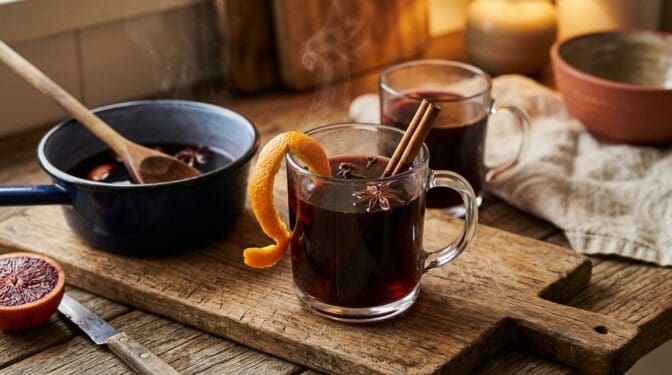
Red wine, orange, cinnamon, clove, star anise, sugar, brandy. Slow simmer for forty-five minutes, never boiled, ladled hot. The drink that turns Friday into a small ceremony.
Why you are pouring this tonight
Mulled wine is the most misunderstood cocktail in the western canon. Most people have only had the version they served at a Christmas market in Berlin in 2014, where the wine was a cardboard-box cabernet from somewhere unspecified, the spices were pre-packaged, and the alcohol had been driven off by an enthusiastic boil. It tasted like a candle that had been lit, blown out, and then submerged in syrup. That is not mulled wine. That is what happens when mulled wine has given up on itself. Real mulled wine is gently warmed, never boiled, with whole spices and fresh citrus and a small slug of brandy added at the very end. It tastes like winter, only more so.
Use a medium-bodied red. Australian shiraz works, but a French Côtes du Rhône is the conventional pick because it has the fruit-forward fruit and the easy tannins that survive the heat without going bitter. A Yalumba Y Series Shiraz at $13 from Dan Murphy’s is the everyday bottle. Do not waste a $40 bottle on this drink; you will not taste the nuance through the spice. Anything you would happily drink without thinking too hard is the right wine. Anything you would normally save for a roast lamb is wasted here.
The brandy at the end is the trick. A small slug of cognac or a halfway-decent brandy, added off the heat right before serving, gives the drink the warmth and the lift the simmered wine has lost. Hennessy VS at $55 from Dan Murphy’s is the everyday brandy; a tablespoon per pour. The brandy is what separates a mulled wine you remember from a mulled wine you wandered into.
What to pour it alongside
End of dinner, around the heater, with a slice of fruit cake or a square of dark chocolate. Mulled wine is a sipper, not a thirst-quencher; the 200ml mug is the right serve, and one mug per person per hour is the pace. It is also the perfect drink for a Christmas-in-July gathering, served in small mugs to people who have just eaten too much pork belly and are negotiating with themselves about a second slice of pavlova. Avoid pairing with anything sharp; the spice in the wine will eat anything citrus or vinegary.
Recipe · Dessert
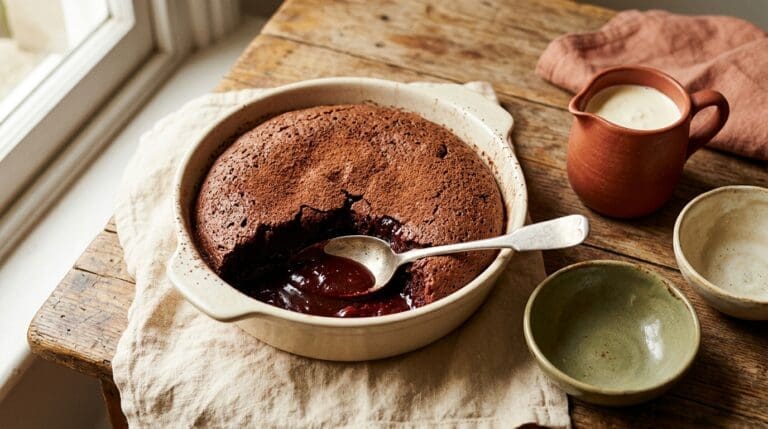
Self-Saucing Chocolate Pudding
The self-saucing chocolate pudding is magic. Why you are cooking this tonight The self-saucing chocolate pudding is magic. You put a dry cake batter in a dish, tip…
Read the recipe →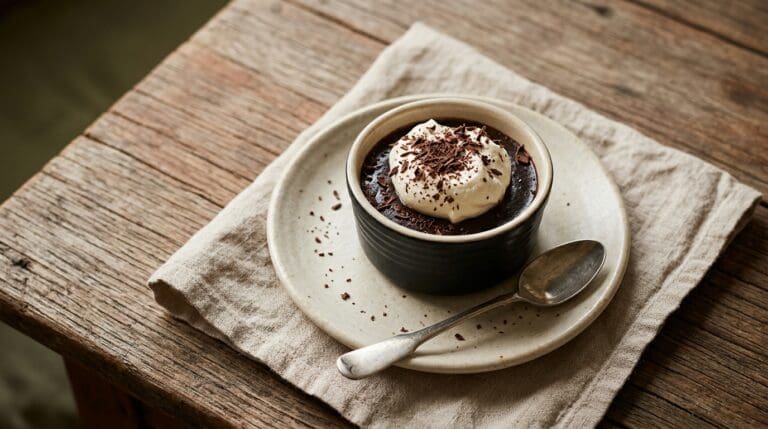
Recipe · Dessert
Dark Chocolate Mousse
The chocolate mousse is the dinner party dessert that makes people think you went to a cooking school in Paris. Why you are cooking this tonight The chocolate…
Read the recipe →
Notes from the kitchen
The temperature is the technique. Bring the wine just to a steam, never to a boil. A boil drives off the alcohol and bullies the tannin into bitterness. The target is around 80°C, hot enough that the spices release their oils, cool enough that the alcohol stays in the wine. A heavy-based saucepan on the lowest gas burner you have, lid off, simmering gently for at least thirty minutes. Forty-five is better. The longer it sits at temperature, the more the orange peel and the spices integrate.
Use whole spices, not ground. Ground cinnamon turns the wine cloudy and grainy and tastes like a candle. A whole cinnamon stick releases its flavour cleanly. Same for cloves: whole cloves, three or four per litre, fished out before serving. Star anise is the hidden hero; one star per litre adds a quiet aniseed warmth that the casual drinker cannot identify but immediately misses if it is not there. The orange peel should be wide pieces of zest, no white pith, taken with a vegetable peeler. Pith is bitter. Zest is the drink.
Two things that go wrong
Mulled wine tastes bitter and harsh
You boiled it, or you used pith from the orange instead of just the zest. Strain through a fine sieve, add a tablespoon of honey to round it back out, warm gently. Next time, peel the zest with a vegetable peeler and avoid the white layer entirely.
Mulled wine is weak and has no kick
You forgot the brandy at the end, or you simmered it too hard and the alcohol cooked off. Add 30ml brandy or cognac per mug just before serving, off the heat, stirred in. The brandy is non-negotiable. It is what makes the drink taste finished.
Variations worth knowing
White mulled wine
Use a Riesling or a Sauvignon Blanc instead of red. Same spices, plus a few sage leaves and a thin slice of fresh ginger. Lighter, more aromatic, the alternative for the guest who has decided they no longer drink red.
Mulled cider
Swap the wine for an off-dry apple cider (Pipsqueak or 5 Seeds Crisp). Same spice mix. Add a tablespoon of dark brown sugar instead of caster. The non-wine version that adults raised on cider houses will quietly prefer.
Mulled non-alc
Use a quality red grape juice or a Seedlip Spice 94 plus pomegranate juice. Same spices, same orange. Heat to the same temperature. The drink for the designated driver who does not want to feel like the designated driver.
Leftovers and make ahead
Refrigerate leftovers in a sealed jar for up to four days. The flavour will continue to deepen; reheat gently on the stove until just warmed through, never boil. The leftovers also become an excellent base for a winter pork glaze: reduce 200ml of mulled wine with two tablespoons of honey until syrupy, brush over a roast pork shoulder for the last fifteen minutes of cooking. The dish becomes the drink and the drink becomes the dish.
Mulled wine ice cubes (frozen in a silicone tray) are also a thing. Drop one into a glass of fresh red wine for a quietly festive touch. Or into a sparkling water for a non-alc spritz that tastes vaguely Christmas-coded.
The recipe
[fd-wprm-placeholder]