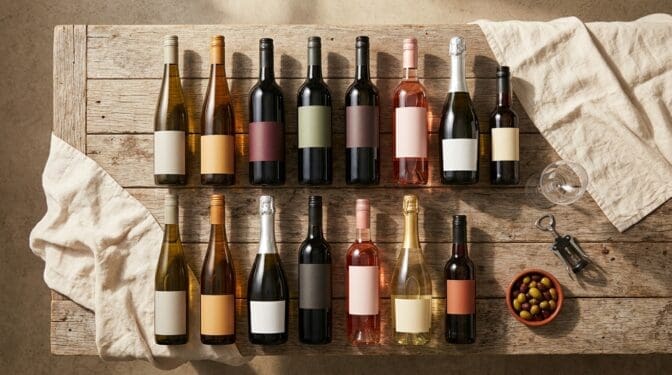
Twenty Australian bottles under thirty bucks that taste like fifty. No imported plonk, no obscure pretensions, no bottles you cannot find at a normal Dan Murphy’s. The list our writers actually drink from on a Tuesday.
- The case for cheap wine in Australia
- How we picked the 20
- The whites (7)
- The pinks and bubbles (3)
- The reds (8)
- The dessert and fortified (2)
- How to actually buy these
- Frequently asked questions
The case for cheap Australian wine
The wine you drink at home does not need to be expensive. The wine you drink with your in-laws on a Sunday should be expensive. Every other bottle, on every other night, the under-$30 zone is where the value lives. Australia is one of the best places in the world to buy decent wine cheaply because we make most of it ourselves and (for now) tax it sensibly. A $25 bottle from a small Victorian or South Australian producer in 2026 is a genuinely good bottle of wine, in a way it simply was not in 2008.
The trick is knowing which producers are punching above weight. The big mass-market labels (Yellowglen, Jacob’s Creek Reserve, Lindeman’s Bin 50) have not changed much in fifteen years and are best avoided unless you are actively trying to fall asleep at 8.30pm on a school night. The boutique end at this price tier is where producers are using their second-tier fruit to make first-tier value bottles, often labelled with a different name to protect their flagship’s pricing. That is what we are looking for.
How we picked the 20
Three rules. First, every bottle must be available at Dan Murphy’s, BWS, or one of the major online retailers (Vinomofo, Naked Wines, Wine Selectors). No cellar-door-only releases, no “you can find this at one bottle shop in Glebe” bottles. Second, every bottle must be available across multiple states, not just locked into one cellar door. Third, every bottle must drink at least $20 above its price. We applied this last test by getting two of our wine-trained mates to taste blind and guess price tier. Anything our mates correctly priced as cheap got cut. Anything they thought was at least $50 stayed in.
We also balanced for grape variety, region, and food pairing flexibility. There is no point listing seven Barossa shiraz bottles, even if they are all genuinely good. The 20 below cover the main grape varieties Australians actually drink (riesling, sauv blanc, pinot gris, chardonnay, viognier, rosé, prosecco, grenache, shiraz, cab sauv, sangiovese, dessert) and span at least eight regions across South Australia, Victoria, Western Australia, and the ACT.
The whites (7 bottles)

Bottle
Yalumba Y Series Viognier ($15)
Stone fruit, honeysuckle, ginger. The cheapest bottle of viognier in Australia worth drinking, and nobody else is even close.

Bottle
Pewsey Vale Eden Valley Riesling ($22)
Lime cordial and slate, dry as a public servant. The bottle that converted my mother-in-law to riesling at a Christmas lunch she did not want to be at.

Bottle
Knappstein Clare Valley Riesling ($20)
The cheaper, sharper Clare riesling. Dry, lemon-lime, mineral. Drinks like it costs $35.

Bottle
Ravensworth Pinot Gris ($25)
Stone fruit, almond, a hint of lees. Canberra District. Restrained, complex, never showy.

Bottle
Turkey Flat Rosé ($22)
The dry Australian rosé that has been showing up at Barossa weddings since the 90s and aging better than the marriages.

Bottle
Dal Zotto Pucino Prosecco ($25)
King Valley prosecco, dry, fresh, and confident. Better than any imported $25 prosecco.

Bottle
Brown Brothers Prosecco ($18)
The everyday workhorse prosecco. Not as dry as the Dal Zotto, but at $18 it punches well above weight.
The pinks and bubbles (3 bottles)
Bottle
Turkey Flat Rosé ($22)
The dry Australian rosé that has been showing up at Barossa weddings since the 90s and aging better than the marriages.
Bottle
Dal Zotto Pucino Prosecco ($25)
King Valley prosecco, dry, fresh, and confident. Better than any imported $25 prosecco.
Bottle
Brown Brothers Prosecco ($18)
The everyday workhorse prosecco. Not as dry as the Dal Zotto, but at $18 it punches well above weight.
The reds (8 bottles)

Bottle
Yangarra Old Vine Grenache ($28)
McLaren Vale grenache with old-vine concentration. Strawberry, dusty earth, supple. The best thing happening in McLaren Vale right now.

Bottle
Spinifex Papillon Grenache ($25)
Barossa grenache, lighter, brighter, more Pinot-like. Perfect for the people who say they don’t like big reds.

Bottle
Penfolds Bin 28 Kalimna Shiraz ($32)
The benchmark Australian shiraz at this price. Dark fruit, vanilla oak, a long finish that earns its name.

Bottle
Hentley Farm The Beauty Shiraz ($28)
Barossa shiraz with restraint. Velvety, dark plum, soft tannins. The dinner-party hero that nobody pretends to know about.

Bottle
By Farr Side By Side Pinot Noir ($28)
Geelong pinot, more affordable than the Tolpuddle but built in the same school. Cherry, beetroot, gentle oak.

Bottle
Cape Mentelle Cabernet Merlot ($28)
Margaret River claret-style blend. Blackcurrant, cedar, structure. The everyday cab the night needed.

Bottle
Vasse Felix Filius Cabernet Sauvignon ($28)
The entry-tier Vasse Felix cab. Margaret River class for $28 instead of the $90 Heytesbury.
Bottle
Ravensworth Sangiovese ($25)
Canberra District sangiovese, sour cherry, a savoury edge. The bottle for Italian food without a $50 price tag.
The dessert and fortified (2 bottles)

Bottle
De Bortoli Noble One Botrytis Semillon (375ml) ($28)
The legendary Australian dessert wine at half-bottle pricing. Apricot, honey, hours-of-finish length.

Bottle
Seppeltsfield Para Grand Tawny (375ml) ($28)
21-year-old Barossa tawny port at half-bottle pricing. Caramel, walnut, dried fruit. Tastes more expensive than it is.
How to actually buy these
The cheapest way to fill out this list is to buy a mixed dozen rather than two or three bottles at a time. Most major retailers run a $99 to $150 mixed-dozen window where the per-bottle price drops by 10 to 25 percent. Vinomofo, Naked Wines, Wine Selectors, BWS Premium and Dan Murphy’s all run mixed-case sales. Sign up for the email lists and wait for the Tuesday drops. We have personally bought eight of the bottles above for under $20 each in mixed dozens that included free shipping.
The second cheap-bottle move is to buy direct from the producer. Most boutique Australian wineries sell at the same price as the bottle shop on their own website, with a free shipping threshold around $200. Six bottles of a single label, mailed to your door, sometimes signed. The producers are friendlier on the phone than you would expect. They are largely small family operations who answer their own emails. Try it once. You will keep doing it.
One warning. If a major retailer is selling a bottle below $15 with a label you have never heard of, it is almost certainly a private label or a bin-end clearance. Some of these are great. Most are anonymous bulk wine bottled under a fake-French-sounding name like Château de la Pretension. Read the back label. If the producer is “cellared by” or “produced for” rather than “made and bottled by,” you are buying re-labelled stock. The bottles in our list above are all single-vineyard or estate-bottled.
Frequently asked questions
What are the best Australian wines under $30?
Our list above is the working starting point: Yalumba Y Series Viognier, Pewsey Vale Riesling, Knappstein Clare Valley Riesling, Penfolds Bin 28 Shiraz, Hentley Farm The Beauty Shiraz, Yangarra Old Vine Grenache, Cape Mentelle Cabernet Merlot, Vasse Felix Filius Cab Sauvignon. All are under $32 most of the time and consistently drink above their price tier.
Is Australian wine better than imported wine at the same price?
At the under-$30 tier, yes, generally. Australia produces enough wine domestically that we can find genuinely good bottles below $30 from boutique producers. Imported wine at the same price has paid more freight, more handling, more middlemen, and is usually mass-produced from less-prestigious regions. There are exceptions: Spanish riojas and Portuguese reds offer good value at this price.
What is the cheapest wine that does not taste cheap?
Our pick is the Yalumba Y Series Viognier at $15. It is a $15 bottle that drinks like a $25 bottle, and is available at every Dan Murphy’s in the country. The Brown Brothers Crouchen Riesling at $15 is the second pick, particularly if you are eating spicy food.
Where can I buy these wines?
Dan Murphy’s and BWS stock most of them in store. The smaller boutique bottles (By Farr, Hentley Farm, Yangarra) may need to be ordered online via Vinomofo, Wine Selectors, or directly from the producer. Vinomofo runs regular mixed-dozen sales at significant discounts.
Do these wines age?
Most under-$30 Australian wines are made for current drinking, not cellaring. The exceptions are Penfolds Bin 28 Shiraz (10+ years), Pewsey Vale Riesling (15+ years for the dry styles), Vasse Felix Filius Cabernet (8+ years), and the Seppeltsfield Tawny (drink immediately, but stable indefinitely). The whites should generally be drunk within 3 years; the reds within 5.
Should I buy by the case?
Yes. Mixed dozens through Vinomofo, Wine Selectors and Naked Wines drop the per-bottle cost by 10 to 25 percent and frequently include free shipping. If you drink wine more than twice a week, mixed dozens are how the people who drink wine for a living buy wine.