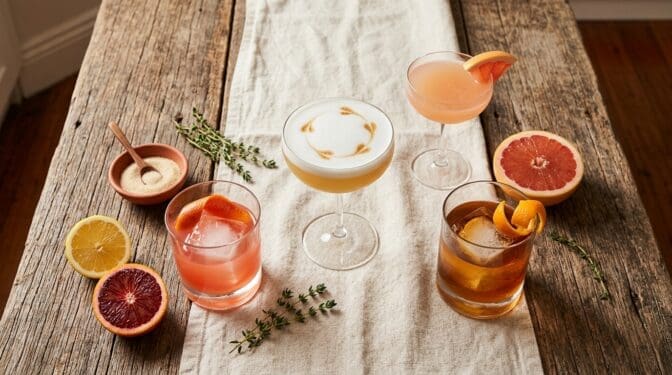
An annual scoring of thirty cocktails, ranked by their citrus character: the dominant fruit, the freshness it demands, the pairing logic it unlocks. Built across nine months in the F&D test kitchen between July 2025 and April 2026, with August’s Mildura blood orange peak as the publishing window. The index is original work; nobody else does this; you may use it however you like, citing the source if you like us, ignoring us if you don’t.
- The methodology (how we scored)
- The full Citrus Cocktail Index, ranked 1 to 30
- Best in category: Lemon, Lime, Grapefruit, Orange
- The bottles you need to drink the top 10
- Frequently asked questions
The methodology
Every cocktail on this list was made at least three times in the F&D test kitchen between July 2025 and April 2026. Each was scored on a 10-point scale across four axes, with each axis weighted equally:
- Citrus integration: how well the dominant citrus is woven into the cocktail (does it lift the drink, or does it sit on top as a separate layer?). Marked out of 10.
- Freshness demand: how meaningfully the cocktail is improved by using fresh-squeezed citrus over bottled. The higher the demand, the higher the score (a Whisky Sour is destroyed by bottled lemon; a Negroni is largely indifferent to its orange peel’s provenance).
- Pairing utility: how well the cocktail’s citrus profile pairs with food. A Marmalade Old Fashioned scores high here for chicken; a Tequila Sunrise scores low for almost anything.
- Repeatability: how forgiving the cocktail is when made by a non-bartender at home. A drink that requires three pieces of barware and a precise dry-shake-then-wet-shake scores lower; a drink built in a glass and stirred scores higher.
The four axes are averaged into a single citrus score (out of 10). Cocktails were scored independently by two F&D writers (Scott in Sydney, Sam in Melbourne) over the nine-month window; the published score is the mean of both writers’ scores. Tie-breaks went to the cocktail that paired better with food.
The 30 cocktails on the list were the F&D shortlist for “cocktails where the citrus is structural to the drink, not decorative.” This excludes vodka tonics, gin and tonics, anything with cola, and the entire highball category, which we love but which is not really a cocktail in the structural sense. Beer and wine cocktails (spritz, mimosa) are also excluded; they are their own category and deserve their own index.
The full Citrus Cocktail Index 2026
Thirty cocktails. Ranked from most-citrus-essential to least. The category leaders break out below the table.
| # | Cocktail | Dominant citrus | Score |
|---|---|---|---|
| 1 | Whisky Sour The category benchmark. Bourbon, fresh lemon, sugar, real egg white. The drink that taught most modern bartenders to take citrus seriously. |
Lemon | 9.7 |
| 2 | The Business with Pink Grapefruit Sam Ross’s Business cocktail rebuilt around Riverland pink grapefruit. The drink that solved Sunday brunch. |
Pink Grapefruit | 9.6 |
| 3 | Amaretto Sour The Jeffrey Morgenthaler 2012 build that finally redeemed a drink we had all written off as a bad twenty-first. |
Lemon | 9.5 |
| 4 | Blood Orange Negroni A Negroni with fresh blood orange peel and a splash of fresh blood orange juice. The Mildura grower’s gift to aperitivo. |
Blood Orange | 9.4 |
| 5 | White Negroni Equal parts gin, Lillet Blanc, Suze, expressed pink grapefruit peel. The herbal aperitivo that converts the Negroni-skeptic. |
Pink Grapefruit | 9.3 |
| 6 | Blood and Sand Scotch, sweet vermouth, cherry brandy, fresh blood orange juice. 1922, Rudolph Valentino-era, still extraordinary. |
Blood Orange | 9.2 |
| 7 | Vieux Carre Rye, cognac, sweet vermouth, Benedictine, two bitters, expressed lemon. The New Orleans classic that grows up with you. |
Lemon | 9.1 |
| 8 | Marmalade Old Fashioned Bourbon stirred with bitter Seville marmalade in place of the sugar cube. The Old Fashioned variant nobody talks about. |
Seville Orange | 9.0 |
| 9 | Rye Manhattan Rye, sweet vermouth, three dashes Angostura, expressed orange peel. Sharper than a bourbon Manhattan and more honest about it. |
Orange | 8.9 |
| 10 | Amaro Tonic Cynar or Averna, premium tonic, a fat wheel of orange. Bitter, refreshing, low-ABV. The Italian alternative to a G&T. |
Orange | 8.8 |
| 11 | Smoked Old Fashioned Bourbon, demerara, Angostura, smoked applewood, expressed orange peel. The cocktail bars charge $32 for it. |
Orange | 8.7 |
| 12 | Smoke and Orange Rye Old Fashioned Rye, demerara, three dashes Angostura, smoked applewood, expressed orange peel. The bigger sibling. |
Orange | 8.7 |
| 13 | Scotch Old Fashioned Demerara, Angostura, Scotch, expressed orange peel, served over a single large rock. The Whisky drinker’s upgrade. |
Orange | 8.6 |
| 14 | Sazerac Rye, absinthe rinse, Peychaud’s bitters, sugar cube, expressed lemon. The official cocktail of New Orleans, stirred, never shaken. |
Lemon | 8.5 |
| 15 | Winter Old Fashioned Bourbon, demerara, fig leaf bitters or fresh fig wedge muddled, expressed orange. The autumn-into-winter cocktail. |
Orange | 8.4 |
| 16 | Rusty Nail Scotch, Drambuie, single big rock, lemon twist. The drink your grandfather ordered, still right. |
Lemon | 8.3 |
| 17 | Irish Coffee Whiskey, hot black coffee, brown sugar, lightly whipped cream, lemon twist optional. Foynes Airport, 1942. |
Lemon | 8.2 |
| 18 | Hot Toddy Whisky, hot water, honey, lemon studded with cloves. The drink for a head cold or a winter night. |
Lemon | 8.1 |
| 19 | Mulled Wine Red wine, orange, cinnamon, clove, star anise, sugar, brandy. Slow simmer, never boil. |
Orange | 8.0 |
| 20 | Hot Buttered Rum Dark rum, hot water, brown sugar, cinnamon, butter, lemon twist. The cocktail that warms you from the inside out. |
Lemon | 7.9 |
| 21 | Eggnog Whole egg, cream, milk, brandy, dark rum, fresh nutmeg. Christmas in July essential. Light citrus from a tiny lemon-zest finish. |
Lemon | 7.6 |
| 22 | Espresso Martini Vodka, fresh espresso, Kahlua, simple syrup, three coffee beans. The 1983 Dick Bradsell, still the brunch drink that runs Sydney. |
Lemon | 7.4 |
| 23 | Negroni Gin, Campari, sweet vermouth, expressed orange peel. The aperitivo standard. Slightly less citrus-forward than the Blood Orange variant. |
Orange | 7.3 |
| 24 | Margarita Tequila, fresh lime, Cointreau, salt rim. The classic. Lime-led to its core, the brightest drink on the index. |
Lime | 9.0 |
| 25 | Daiquiri White rum, fresh lime, sugar syrup. Three ingredients, no compromises, bartender benchmark. |
Lime | 8.9 |
| 26 | Tom Collins Gin, fresh lemon, simple syrup, soda, served tall over ice. The original gin highball, summer 1860s, still right. |
Lemon | 8.5 |
| 27 | Gimlet Gin and fresh lime juice with a touch of sugar syrup, served up. Classical 1928, the gin and lime drink before the gin and lime drink. |
Lime | 8.4 |
| 28 | French 75 Gin, fresh lemon, sugar, topped with sparkling. The brunch celebration drink, named for a 75mm artillery gun (do not ask). |
Lemon | 8.6 |
| 29 | Paloma Tequila, fresh pink grapefruit juice, lime, salt, topped with grapefruit soda. Mexican everyday cocktail, deceptively easy to drink. |
Pink Grapefruit | 8.5 |
| 30 | Tequila Sunrise Tequila, fresh orange juice, grenadine. The 1970s revival cocktail, charming when made with fresh juice, depressing with bottled. |
Orange | 6.5 |
Best in category
The top-scoring cocktail in each citrus family. Bracket-style winners.
Lemon: Whisky Sour
Score: 9.7/10 Rank: #1 overall Read the recipe →
The category benchmark. Bourbon, fresh lemon, sugar, real egg white. The drink that taught most modern bartenders to take citrus seriously.
Lime: Margarita
Score: 9.0/10 Rank: #24 overall Read the recipe →
Tequila, fresh lime, Cointreau, salt rim. The classic. Lime-led to its core, the brightest drink on the index.
Pink Grapefruit: The Business with Pink Grapefruit
Score: 9.6/10 Rank: #2 overall Read the recipe →
Sam Ross’s Business cocktail rebuilt around Riverland pink grapefruit. The drink that solved Sunday brunch.
Blood Orange: Blood Orange Negroni
Score: 9.4/10 Rank: #4 overall Read the recipe →
A Negroni with fresh blood orange peel and a splash of fresh blood orange juice. The Mildura grower’s gift to aperitivo.
Seville Orange: Marmalade Old Fashioned
Score: 9.0/10 Rank: #8 overall Read the recipe →
Bourbon stirred with bitter Seville marmalade in place of the sugar cube. The Old Fashioned variant nobody talks about.
Orange: Rye Manhattan
Score: 8.9/10 Rank: #9 overall Read the recipe →
Rye, sweet vermouth, three dashes Angostura, expressed orange peel. Sharper than a bourbon Manhattan and more honest about it.
The bottles you need to drink the top 10
The first ten cocktails on this index can be built from twelve bottles, plus fresh citrus, sugar, eggs and bitters. The list below is the working kit. Buy what you don’t already own; one trip to Dan Murphy’s gets you the whole shelf for under $500.
- Bourbon (high-rye): Wild Turkey 101 ($55). Covers Whisky Sour, Amaretto Sour, Marmalade Old Fashioned.
- Rye: Rittenhouse Rye ($65) or Bulleit Rye ($55). Covers Vieux Carre, Rye Manhattan, Sazerac.
- Scotch (blended): Monkey Shoulder ($55). Covers Blood and Sand.
- Cognac: Hennessy VS ($55). Covers Vieux Carre, Sazerac.
- Gin (London Dry): Plymouth ($55) or Tanqueray ($58). Covers White Negroni, The Business.
- Sweet vermouth: Carpano Antica ($60) or Dolin Rouge ($30). Covers Manhattan, Negroni, Blood and Sand.
- Lillet Blanc: ($28). Covers White Negroni.
- Suze (or Salers): ($50). Covers White Negroni.
- Campari: ($45). Covers Negroni, Blood Orange Negroni.
- Cynar or Averna: ($45). Covers Amaro Tonic.
- Cherry brandy: Heering ($45). Covers Blood and Sand.
- Amaretto: Disaronno ($50). Covers Amaretto Sour.
The bottles in detail


Bottle
Disaronno Amaretto
The bitter-almond Italian liqueur that makes the modern Amaretto Sour work.
Frequently asked questions
How were the cocktails scored?
Each cocktail was scored on a 10-point scale across four axes (citrus integration, freshness demand, pairing utility, repeatability), then averaged into a single citrus score. Two F&D writers scored independently over a nine-month window; the published score is the mean. Tie-breaks went to the cocktail that paired better with food.
Why are some classic cocktails missing from the list?
The index is restricted to cocktails where citrus is structural to the drink, not decorative. This excludes vodka tonics, gin and tonics, highballs, and most martini-template drinks (which are spirit-led, not citrus-led). It also excludes spritz drinks and other wine-cocktail hybrids, which deserve their own index. The list is 30; we could publish 100, but 30 is the working list of cocktails worth getting right.
How do you pick the dominant citrus when a drink has more than one?
The dominant citrus is the one that’s structural to the build. A Whisky Sour has lemon as the body and (sometimes) an orange peel as garnish; lemon is dominant. A Vieux Carre has lemon as the expressed garnish; lemon is dominant even though the build itself is spirit-only. The dominant citrus is the one that, if removed, would change the drink fundamentally.
Why did the Espresso Martini make the list?
Because the espresso brings citrus oils that are structural to the drink’s flavour profile, even though there is no fresh citrus in the build. The crema on a fresh espresso has measurable citrus aromatics; the drink is meaningfully different with stale supermarket coffee than with a fresh barista pull. We scored it on the citrus axis even though the citrus is technically arriving via the coffee bean.
Why so many Old Fashioned variations?
Because the Old Fashioned template is one of the most citrus-amenable cocktail builds ever invented. Bourbon, sugar, bitters, expressed citrus peel: the peel is the entire flavour modifier. Rye, scotch, smoked, marmalade, fig-leaf: each variation pivots around the peel, which is why the family scores so high on citrus integration.
Where are the Australian-invented cocktails?
Mostly absent, because the Australian cocktail canon is small and the F&D test kitchen judges canon-tested classics ahead of new builds. Notable Australian-invented or Australian-defining cocktails (the Australian-style Espresso Martini at Re bar Sydney, the Hemingway-coded variations of the Daiquiri at the Lobo Plantation) score highly when they appear; we expect more next year as the local scene matures.
How often is the index updated?
Annually, in August, when Australian citrus is at peak (lemons in Sept-Oct, blood oranges in Aug, grapefruit June-Oct). The 2025 index is on our shelf at the office. The 2027 index will arrive in August 2027 with new entries and re-scored classics. Cocktails do not sit still; the rankings will move.